











On Oct. 14, the skies will dim across much of the U.S. as a rare annular solar eclipse sweeps coast-to-coast. For millions, it will be a breathtaking celestial event. For grid operators, it’s a stress test in the making.
When the moon slides between Earth and the sun, it doesn’t just cast a shadow — it cuts off the lifeline for solar panels. In regions like Texas and California, where solar power now supplies a significant share of electricity, that sudden drop in sunlight could ripple through the grid in minutes. The stakes? Reliability, market stability, and the delicate balance of supply and demand.
Grid operators aren’t leaving this to chance. In recent days, the Electric Reliability Council of Texas (ERCOT) and the California Independent System Operator (CAISO) have issued public notices warning energy companies to prepare for steep declines in solar output. These alerts underscore a new reality: as renewable energy grows, even the rhythms of the cosmos can challenge grid stability.
The warnings
Below are screen captures of CAISO’s and ERCOT’s public notices from their websites.
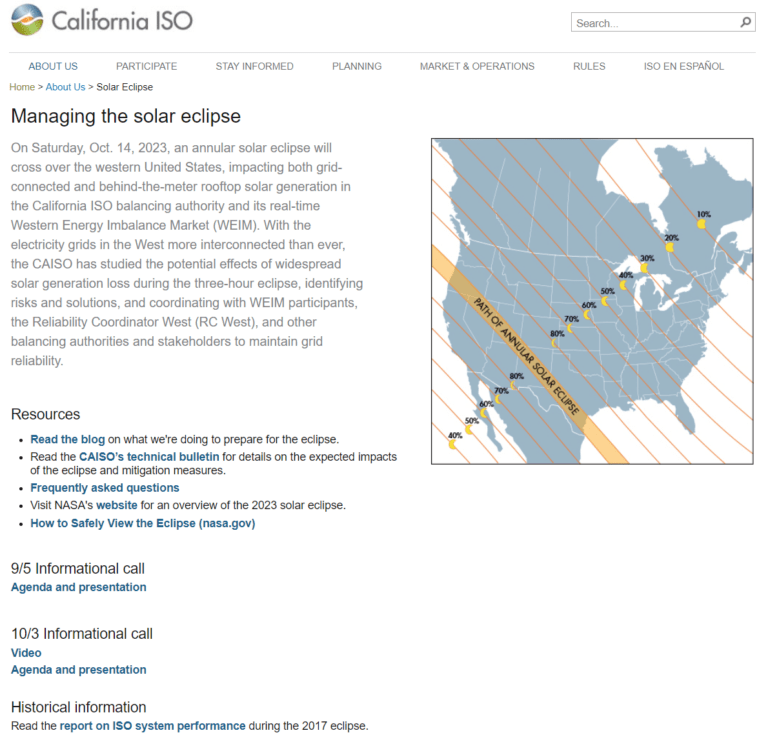
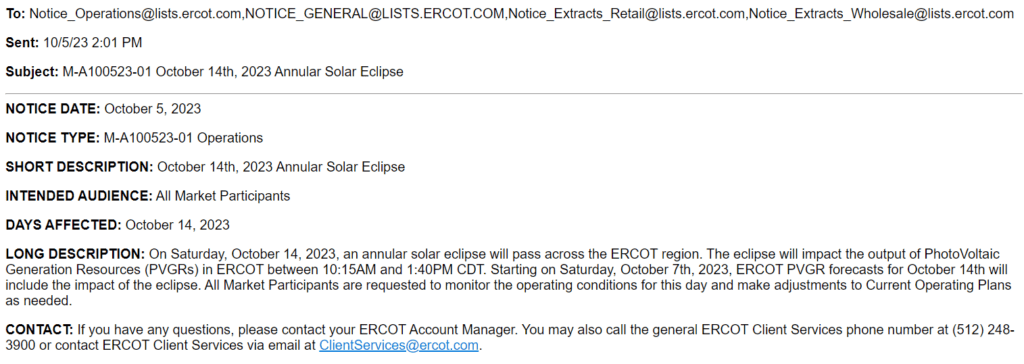
ERCOT’s notice highlights how solar-heavy Texas could face major reliability and market challenges if photovoltaic output plunges as expected. CAISO warns of steep ramping needs and even the possibility of dual demand peaks — an operational puzzle driven by California’s surge in rooftop solar.
Inside the industry response
The first heads-up at PCI came from Dan Crawford, our senior director of Client Success, who dropped ERCOT’s notice into our #energy-industry Slack channel — a space where dozens of us trade insights on the latest energy news every day.
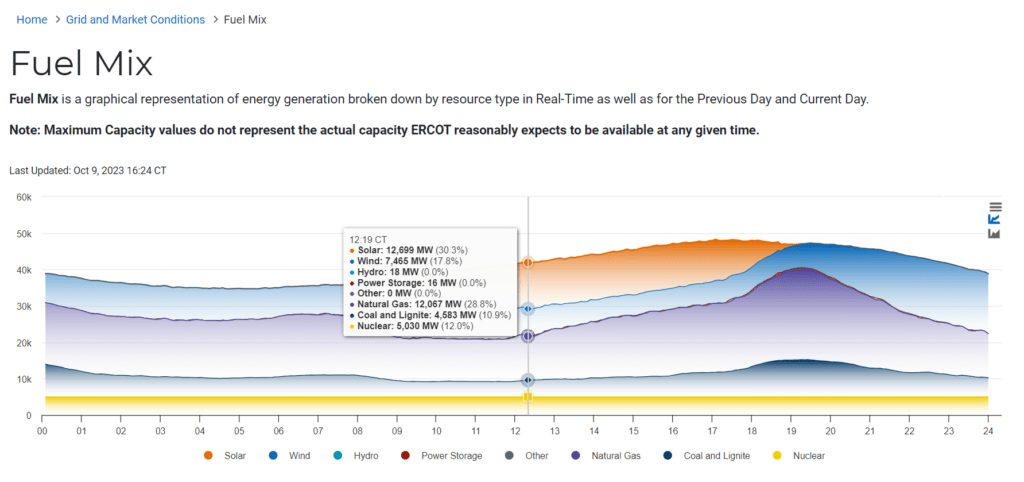
“This [image above] shows Sunday, Oct. 8 (also a weekend day),” Dan wrote. “The fuel mix was over 30% solar mid-day (12–13 gigawatts), so this could be a very significant portion of the normal ERCOT generation during the impacted times.”
CAISO’s analysis predicts a staggering 10,800 MW ramp in solar production over just 90 minutes as the eclipse passes. The loss of rooftop solar could also create an unprecedented dual morning peak in demand. Careful coordination will be essential.
What the operators are saying
When I reached out to CAISO’s media team, they emphasized confidence in their planning:
“The California ISO has been in constant communications with its stakeholders and market participants to carefully manage and mitigate the impacts of the solar eclipse,” said Anne F. Gonzales, CAISO’s senior public information officer. “We expect that our planning and coordination with stakeholders will protect the reliability of the grid during Saturday’s eclipse.”
ERCOT echoed that sentiment:
“ERCOT does not expect any grid reliability concerns during the eclipse. On October 14, 2023, an annular solar eclipse will pass across the ERCOT region and impact solar Resource power production between 10:15 A.M and 1:45 P.M. CDT. Solar forecasts will continue to be updated as an hourly average to the date of eclipse: Solar forecasts will continue to be updated as an hourly average to the date of eclipse: https://www.ercot.com/mp/data-products/data-product-details?id=NP4-737-CD..”
Why it matters
ERCOT now has over 5,000 MW of utility-scale solar capacity, while California’s rooftop solar boom adds another layer of complexity. A solar eclipse can slash PV output by 70–80% in affected areas — a massive generation loss if unplanned for.
Market participants should be ready with flexible conventional generation, battery storage, shared reserves, demand response, and precise forecasting. This isn’t just about one day — it’s a glimpse into the future of grid management.
Beyond the eclipse
As our president and COO, Javier Martin, put it:
“Heatwaves, wildfires, and extreme weather are becoming more common. One that isn’t that common — and few people associate with impacting power systems — are geomagnetic storms. I’ve seen operational notices from RTOs related to this, and they always catch my attention. RTOs have to be aware not only of Earth’s climatological conditions, but also space weather.”
Early warnings like those from ERCOT and CAISO are now an essential line of defense, helping markets adapt smoothly to disruptions — whether they come from Earth or beyond.
The bottom line: Events like this eclipse highlight the need for advanced forecasting, flexible portfolio management, and sophisticated optimization tools to keep the lights on in a renewable-driven world. Visit our Sustainable Energy page to learn how PCI’s solutions help integrate solar and wind seamlessly.