











The western U.S. electricity grid is entering a period of rapid transformation. Across the West, utilities are navigating a landscape of evolving market structures—from real-time only markets and bilateral arrangements to full Day Ahead and real-time markets with Extended Day Ahead Market (EDAM) and Markets+—all while grappling with increasing demands for reliability and resource adequacy.
Against this backdrop, the Western Resources Adequacy Program (WRAP) has become a strategic inflection point that will shape the next generation of market design. With WRAP participants committing—or reconsidering their commitments—in recent weeks, the choices made in the coming months will influence Markets+ Version 1 protocols, utility participation decisions, and long-term grid adequacy planning across the region.
Why WRAP is foundational to Markets+
Operated by the Southwest Power Pool (SPP) and governed by the Western Power Pool, WRAP is a coordinated resource adequacy framework. By leveraging transmission availability and market hubs, it matches utilities with resource shortfalls to willing providers at a tariff-based price, enabling more efficient resource sharing and stronger overall system reliability.
Its operational components—WRAP Ops, Forward Showing, and Settlements—serve distinct purposes. WRAP Ops monitors real-time adequacy and participant commitments. Forward Showing requires participants to demonstrate, months in advance, that they have secured sufficient resources and transmission capacity to meet their share of regional demand for an upcoming season.
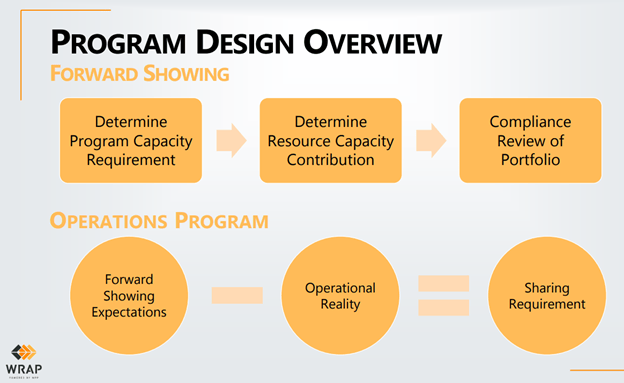
Image credit: WRAP.
Settlements reconcile actual resource use in near real-time, allowing participants to share capacity and apply deficiency charges if shortfalls remain during peak operational periods.
SPP has embedded these elements into Markets+ architecture and protocols, and participation in WRAP is a prerequisite for participation in Markets+.
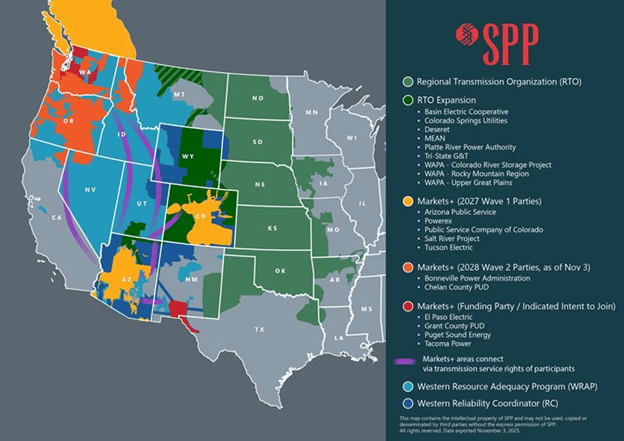
This map illustrates WRAP (light blue) and Markets+ regions (gold for Phase 1 and orange for Phase 2). Source: Southwest Power Pool
Upcoming changes to WRAP will impact Markets+
We’ve just passed the October 31, 2025, commitment deadline, a significant milestone for WRAP. Of the utilities eligible to participate in the program’s October 1, 2027, go-live, sixteen confirmed their commitment.
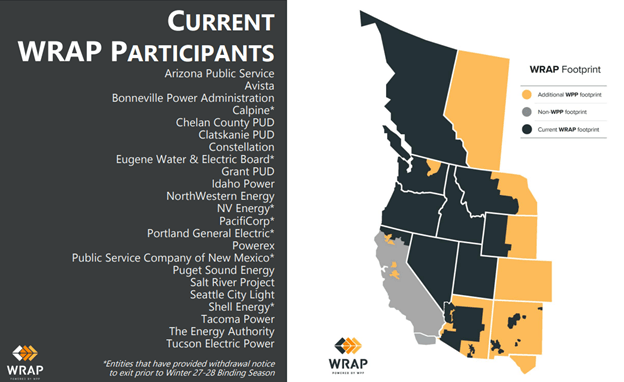
Notably, the Western Power Pool introduced a “soft return window” through September 15, 2026, signaling flexibility and a willingness to adapt the program based on participant feedback. This dynamic underscores a broader principle: participation decisions are not just administrative; they are strategic, informed by how well program design aligns with operational needs and market participation ambitions.
Utilities that withdrew from WRAP cited a desire for increased transparency, design improvements, and clearer integration pathways. These sentiments appear to be shared, to some degree, even by participants who have committed to moving forward.
How WRAP addresses these concerns over the next couple of quarters will determine whether any of the withdrawn participants return to WRAP.
Changes to WRAP will also influence the Markets+ ecosystem. Markets+ design teams are actively refining protocols toward the Version 1 release, and any changes to WRAP will influence their decisions. They may also sway utilities that have yet to declare their commitment to Markets+.
WRAP Participants Also Committed to Participate in Markets+ (as of Dec. 15, 2025)
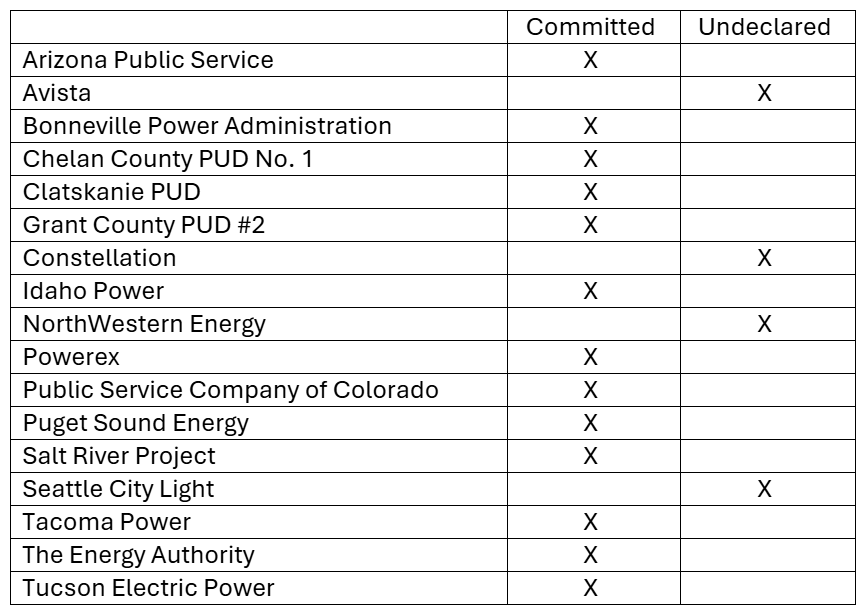
SPP’s dual role—executing WRAP and designing and operating Markets+—offers a unique opportunity for alignment. By serving as both a technical partner and facilitator, SPP can bridge the operational realities of WRAP with the market-oriented goals of Markets+, creating a seamless interface that reduces friction for participating utilities and improves overall market efficiency.
PCI’s perspective: what we’re seeing in the rooms that matter
In the months ahead, WRAP redesign milestones and public documentation updates will provide clarity on program evolution. There are four task forces working on various aspects of the redesign: Planning Reserve Margin, Qualifying Transmission, Day Ahead Markets, and Demand Response.
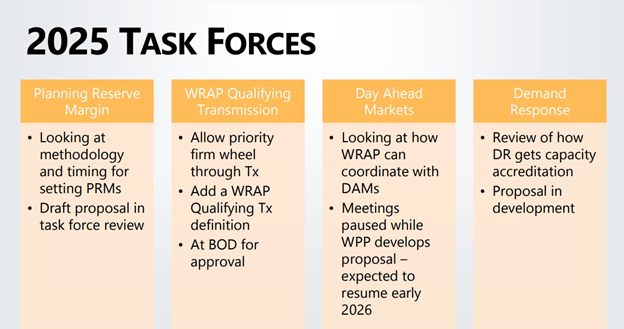
Participants and market watchers are closely following what’s happening with the Day Ahead Markets task force, as this group will review proposed updates aimed at better integrating and support DA markets and ultimately reframe how Markets+, and to some extent EDAM, will integrate with WRAP.
While the team is currently awaiting Executive Committee approval to continue working on design updates, current topics under discussion include, but are not limited to:
- Provisions for discounted deficiency charges
- Provisions for sharing between Northwest and Southwest
- Integrations with DA Markets, including transfers, planning and adequacy
- Expanding data sharing between participants to go beyond the high-level data shared today to more detailed and higher quality data from DA markets.
Meetings are expected to resume early next year. We anticipate decisions from DA Task Force to be taken to the Board of Directors for approval by June 2026. Implementation of any changes will follow that approval.
As a non-voting member of the WRAP Day – Ahead Task Force and a long-standing technical partner, PCI has a front-row seat to WRAP’s evolution. We’ll keep you updated as things progress.
We have been in production with WRAP Ops since early 2025 and are preparing for Forward Showing and Settlements support well in time for binding seasons.
We are still in WRAP’s non-binding transition period as the program prepares for its first binding season in November 2027. Forward-showing data for this initial binding cycle must be submitted by March 31, 2027, well in advance of the November start date. To meet these obligations, participants will need to be actively engaged in the system and practicing during the non-binding period through 2026, ensuring they are fully ready when binding requirements take effect.
Most participants — regardless of whether they are also joining Markets+ — will need to be active in the system and practicing during Q3–Q4 2026, ensuring they can meet all requirements when the first binding season begins in late 2027.
Beyond these milestones, the broader question remains: how will resource adequacy frameworks shape competition and coordination between Markets+ and EDAM? The September 2026 soft commitment deadline will likely prompt further re-evaluations, potentially shifting participation patterns once more.
A rare window for structural alignment in the West
WRAP’s ongoing redesign is more than operational fine-tuning — it is foundational to the future of western markets. The coming year offers a unique opportunity to align resource adequacy frameworks with market design, enabling utilities, regulators, and solution providers to make informed decisions in a rapidly evolving landscape. By staying engaged, stakeholders position themselves to influence the trajectory of both WRAP and Markets+, fostering a more resilient, transparent, and strategically coherent Western grid.
Learn more about how PCI can help your organization optimize participation in Markets+ or schedule a demo of our integrated solution on our SPP Markets+ Landing Page.
Justin Shearer, VP of Customer Experience, contributed to this blog post.