







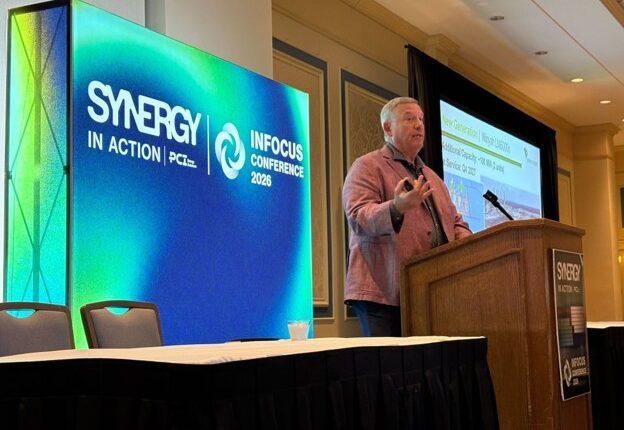
I’ve been in this industry for decades, and I’ve never seen anything like what’s happening right now. The amount of change driven by technology, the opportunities with hyperscalers and data centers, the demand for new transmission and generation capacity — the growth is unprecedented. It is a great time to be in this business. It’s also one of the most challenging, and at Santee Cooper, the way we manage that challenge comes down to a single idea: synergy. The team achieves more together than any individual could alone.
A little about who we are
Santee Cooper is a state-owned, vertically integrated electric and water utility headquartered in Moncks Corner, South Carolina. We’re one of the nation’s largest public power utilities, and between our retail and wholesale operations we serve more than 2 million South Carolinians. We’re also a wholesale drinking water provider to more than 260,000 people.
Our reach runs across the state. We’re the primary power supplier to South Carolina’s electric cooperatives, we serve municipalities and large industrial and military customers directly, and we run regional water systems that supply communities across multiple counties. Our generating fleet today is anchored by coal, with natural gas, nuclear, hydro, oil, and a growing base of solar rounding out the mix.
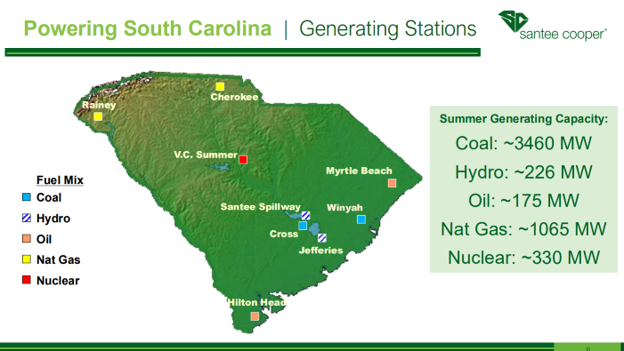
A look at Santee Cooper’s generating fleet and summer capacity by fuel type. Credit: Mike Finissi, Deputy CEO & Chief Operating Officer, Santee Cooper, from his 2026 PCI INFOCUS Conference presentation.
The growth is real, and it’s accelerating
South Carolina is one of the fastest-growing states in the country, and the Myrtle Beach region has ranked as the fastest-growing metro area in the U.S. for years running. In 2025 alone, the state saw more than $9 billion in announced economic development projects and over 8,000 new jobs, with a large share of that tied to the information technology and software development industry.
We feel that growth directly. Santee Cooper added nearly 20,000 new residential and commercial customers between 2023 and 2025. We set six new system load peaks in 2025, with a new winter high of 5,414 MW — and we’d already blown past that by February 2026, hitting 5,637 MW. Years ago, a four- or five-megawatt industrial load was cause for celebration. Today we’re seeing single interconnection requests of 70 to 300 megawatts, with hyperscalers and data centers telling us they want to ramp toward 1,000 megawatts in just a few years.
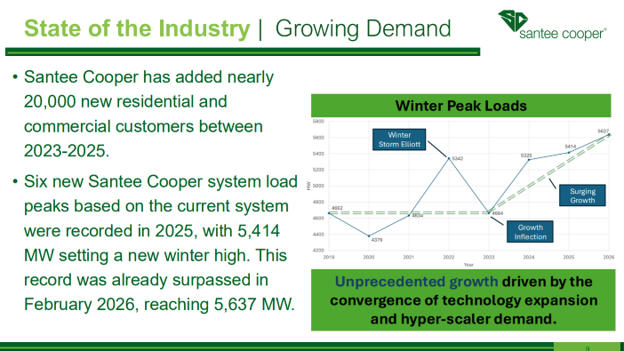
Winter peak loads dipped, then surged, driven by the convergence of technology expansion and hyperscaler demand. Credit: Mike Finissi, Deputy CEO & Chief Operating Officer, Santee Cooper, from his 2026 PCI INFOCUS Conference presentation.
When you look at our long-range forecast, capacity needs begin in 2027 and grow to roughly 2,000 megawatts after the planned retirement of our Winyah Generating Station — a retirement that only happens once we have enough new resources in place to reliably meet the load. You can’t build a power plant in four years. So we didn’t wait.
Building the right kind of capacity
Our 10-year capital plan calls for about $10 billion of investment to support reliability and load growth. When our CEO Jimmy Staton looked at the gap between our load and our generation, the direction was clear: squeeze out as many megawatts as we can, as soon as we can.
That’s playing out across a portfolio of projects. We have a 300 MW battery energy storage system coming online at Jefferies in 2027, along with new natural gas peaking units at Winyah and a combined cycle conversion at Rainey. Looking further out, we’re partnering with Dominion Energy South Carolina on a 50/50 combined cycle joint build at Canadys, and our solar capacity is set to climb from roughly 490 megawatts today toward more than 1,000 megawatts within a few years. We’re transitioning away from base-loaded coal and toward a more flexible, dispatchable mix — because in South Carolina you can feel all four seasons in a single day, and you can’t ramp a coal plant fast enough to keep up.
We’re also building new nuclear. The Fairfield project is targeted to add 2,200 megawatts for South Carolina, and we’re working with Brookfield to coordinate site assessment and development as their team expands. We’re public power — we don’t have shares or a hundred-billion-dollar market cap behind us — so getting the financing and the partnerships right matters enormously.
Supply chains are testing all of us
Here’s where the challenge gets real. The equipment we need to build all of this is on lead times I would not have believed a few years ago. A power transformer can run 200 weeks. A circuit breaker, 156. Years ago, an expedited switchyard transformer might take 14 months — now we’re looking at four years, and there’s no expediter to call. I’ve had a reputable, century-old transformer company come to us and simply refuse to honor a signed contract: new schedule, new price, take it or leave it.
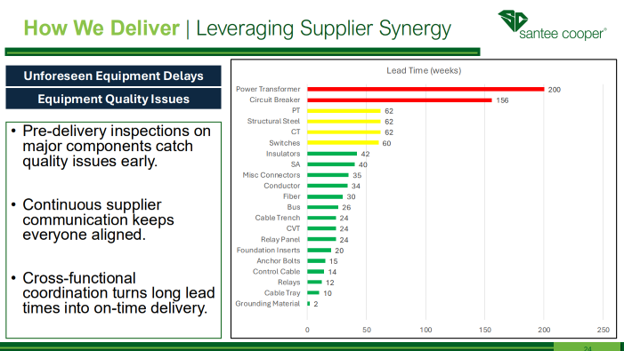
Equipment lead times in weeks, with power transformers and circuit breakers stretching past three years. Credit: Mike Finissi, Deputy CEO & Chief Operating Officer, Santee Cooper, from his 2026 PCI INFOCUS Conference presentation.
So we manage it the only way that works: together. Our procurement, planning, and project teams coordinate to secure major materials early — we were able to beat the market on some breakers and transformers by sourcing years ahead, before tariffs and demand absorbed the available capacity. Finance, engineering, and project teams jointly set contingency across a bundle of projects rather than betting on any single one. We run pre-delivery inspections to catch quality issues before they reach the field, and we lean on long-term supplier alliances to lock in pricing. We’re also keeping the work close to home: if you want to do business with us, we’d like you to open a shop in South Carolina or the Southeast, so our local communities share in the economic opportunity.
Where technology and partners come in
None of this happens without strong partners, and that includes our technology providers like PCI Energy Solutions. As we scale, partners like PCI help us accelerate delivery, use data-driven insights to manage spend and mitigate risk, and adopt the kind of innovative solutions that let us grow with confidence. AI is a big part of what all of us are doing now — and to be clear, that’s not about replacing people. It’s about getting more done than we ever thought we could, and about adopting change faster than the next utility. The companies that come out ahead will be the ones that move quickly.
Keeping it in focus
At the end of the day, all this growth and all this investment comes back to people: the families counting on affordable, reliable power, and the businesses driving our state’s economy. We leverage synergy to reduce risk — turning potential risks into manageable challenges so projects get done safely, on time, and on budget.
When I talk about this being the best time to be in the industry, I mean it’s also the best time for you to challenge yourself and to do more than you thought you could. Years from now, when you look back, these will be the good old days.
Want to learn more about how Santee Cooper is powering South Carolina? Visit santeecooper.com, or explore the economic growth happening across the state at poweringsc.com.
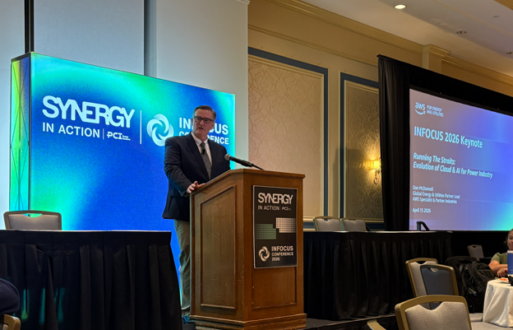
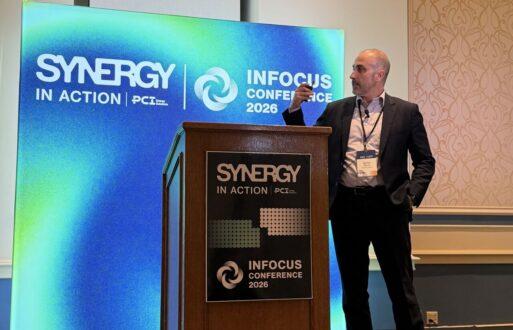
This post was adapted from a keynote presentation delivered at the PCI INFOCUS Conference 2026, PCI’s annual customer conference, where the theme was “Synergy in Action.”