












With U.S. natural gas consumption hitting a record-high average of 92.0 billion cubic feet per day in 2025, efficiency and accuracy have become non-negotiable for any successful generation asset manager. Behind every cubic foot delivered is an invoice that has to be reconciled against pipeline tariffs, and for teams still shadowing those charges with manual data entry, more volume just means more room for error, and more hours spent chasing discrepancies that turn out to be nothing more than an outdated rate or a fat-fingered entry.
This blog post walks you through PCI’s Natural Gas Management Charges (NGM Charges) module and explains how this solution can optimize workflows surrounding pipeline invoice reconciliation.
We’ll dive into how automated processes retrieve critical data directly from pipelines to eliminate double entry, how the platform presents data in a way that aligns with users’ existing workflows, and how the solution’s flexible framework is built to evolve alongside your business.
Automated data retrieval
Despite NAESB releasing and implementing the first version of their electronic data interchange (EDI) standards in 1996, many ETRM solutions still rely on manual entry of tariff data when shadowing pipeline invoices. This leaves users prone to data entry errors that waste time chasing false discrepancies. Our solution allows you to spend that time resolving legitimate discrepancies rather than being burdened with the data entry required to find them.
In the NGM Charges module, users can download fuel loss and financial rate data from EDI compliant pipeline tariffs for all applicable rate schedules, allowing this data to seamlessly integrate with configured transportation, storage, operational balancing, and other types of pipeline contracts. This data is managed in the Tariff screen, where users can quickly see the current effective date and corresponding rate value of all tariff rates as well as their historical values over time. More importantly, if a rate is changed or updated, existing charges are automatically updated with the new information, eliminating the need for manual intervention to calculate updated results.
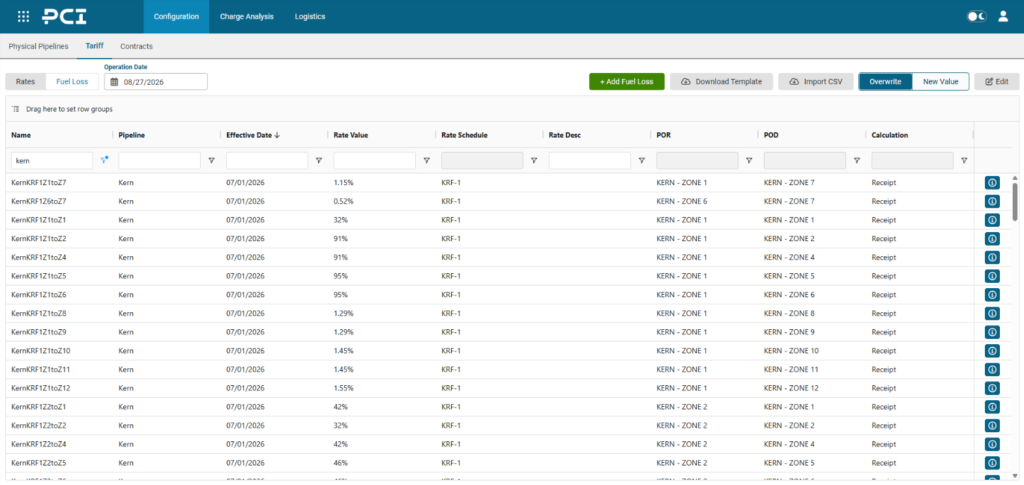
The Tariff screen in NGM Charges, showing EDI-sourced rate and fuel loss data pulled directly from pipeline tariffs, with effective dates and rate values managed automatically.
Data presentation
The worst kept secret in the ETRM industry is that the biggest competitor to ETRM applications is spreadsheets. Their ability to filter and pivot data in meaningful ways gives each user a customized view of the same dataset, a flexibility that often pulls users out of their ETRM platform entirely. PCI recognized this need and built similar flexibility directly into the NGM Charges module, so that users can filter, pivot, organize, and search for data without ever needing to export it elsewhere.
The Charge Analysis screen offers a multitude of ways to quickly review charge data, making pipeline invoice reconciliation a breeze. KPI Cards let users see total charges at a quick glance, as well as disaggregate totals by charge code or charge class, without digging into the details of individual charge records. The Charge Analysis grid can be displayed in Grid mode or Pivot mode depending on how users prefer to explore their data. Summary totaling is provided in both modes so that users can see quantities and amounts at every relevant aggregation level. Users can quickly filter by pipeline and/or contract to narrow their view and speed up reconciliation.
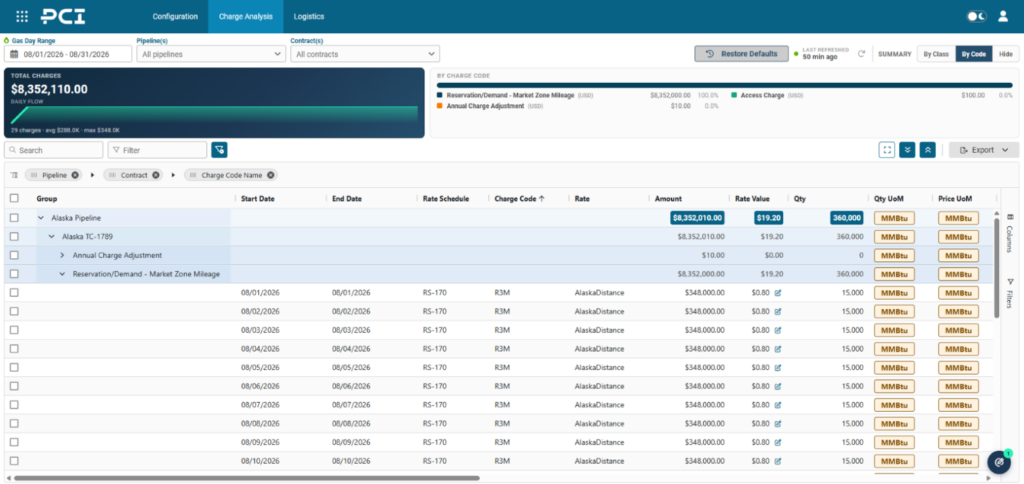
The Charge Analysis screen in Grid mode, with charges grouped by pipeline, contract, and charge code; summary totals calculated at every level of the hierarchy.
A flexible framework built to scale with you
One of the biggest lessons learned from reviewing legacy natural gas functionality as we designed NGM Charges was that vendors often promote an industry standard solution, only for customers to discover mid-implementation that the intricacies of their specific pipelines require a host of custom, one-off solutions. While NAESB offers standards and guidelines for pipelines to follow, time and time again, we see that pipeline operators will push the limits of those standards and in some cases disregard them altogether. The NGM Charges framework was designed to absorb these intricacies directly into the product itself, offering long-standing solutions backed by our development team with ongoing support, rather than one-off custom builds. This eliminates risk after go-live and allows our pipeline footprint to grow in step with our customer base.
The best example of this is NGM Charges’ rate calculation framework. For rates related to transportation contracts alone, we offer more than 10 different calculation methodologies for resolving natural gas transportation charges. If we come across a need for a new calculation, our product team can quickly build, implement, and deploy it to enable the desired functionality.
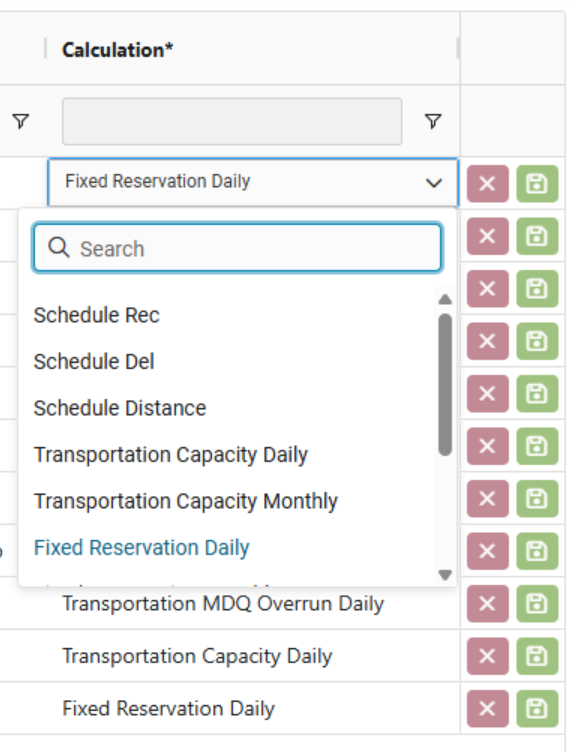
NGM Charges’ calculation framework, offering more than 10 built-in methodologies for resolving transportation charges.
Efficiency and accuracy built in
PCI’s NGM Charges module modernizes pipeline invoice reconciliation by eliminating the need for manual intervention at every step. Instead of spending time preparing and configuring data, users can focus on validating results, letting the system do the heavy lifting so your team doesn’t have to.
When you’re not second-guessing your data or troubleshooting false discrepancies, you free your team up to focus on what actually matters: confident, accurate, and timely decisions.
Want to see it in action? Reach out to our team to see NGM Charges applied to your own pipelines and tariffs.