









Picture the two ends of how power actually gets to your home. On one end, there’s the physical equipment and controls that run the grid itself. On the other hand, there’s the financial side: billing, accounting, and the systems that turn electricity into a number on an invoice. Those two worlds don’t talk to each other well on their own. That’s the gap we built PCI to fill.
Everything between those two worlds is what PCI does: forecasting, trading, scheduling, risk management, settlements, and billing, plus the handful of specialized functions in between.
This piece walks through how PCI’s platform covers that full distance — five solution areas, from portfolio optimization through outage management, built on one system that’s evolved over three decades and is now layered with AI. If you’re trying to understand where PCI fits in your operation, or which of the five areas matters most to you, this is the map.
I could go on for a long time. But the point is simple: We cover end to end, from generation to billing and monetization, from front office to back office. And we built all of it into a single platform, with common functionality at the technology layer, the database layer, the reporting layer, and across integration and analytics.
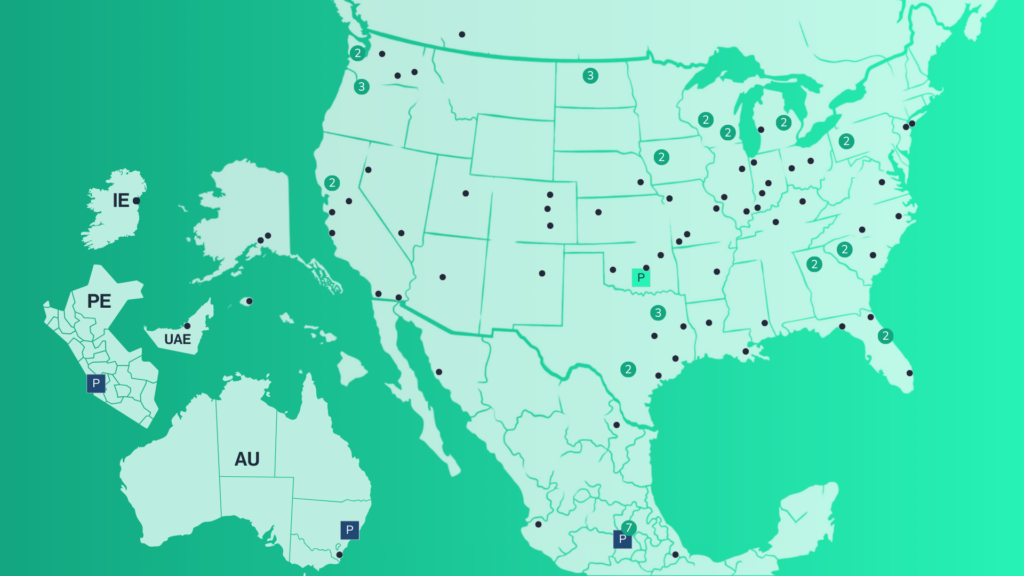
We’ve also built in communication to all 10 North American RTO markets — seven in the U.S., two in Canada, one in Mexico — plus several trading exchanges like ICE and the NAESB protocols used for e-tagging, OASIS reservations, and gas pipeline nominations.
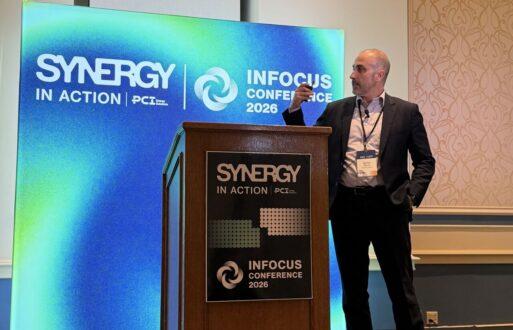
Javier Martin, PCI Energy Solutions’ President and COO, breaks down what PCI does and where it fits, from operational technology to financial systems, covering the full backbone of your wholesale power and transmission operations
Five solutions, one platform
We classify what we do into five solution areas: ETRM, Bid-to-Bill, Portfolio Optimization, Transmission, and Outage Management.
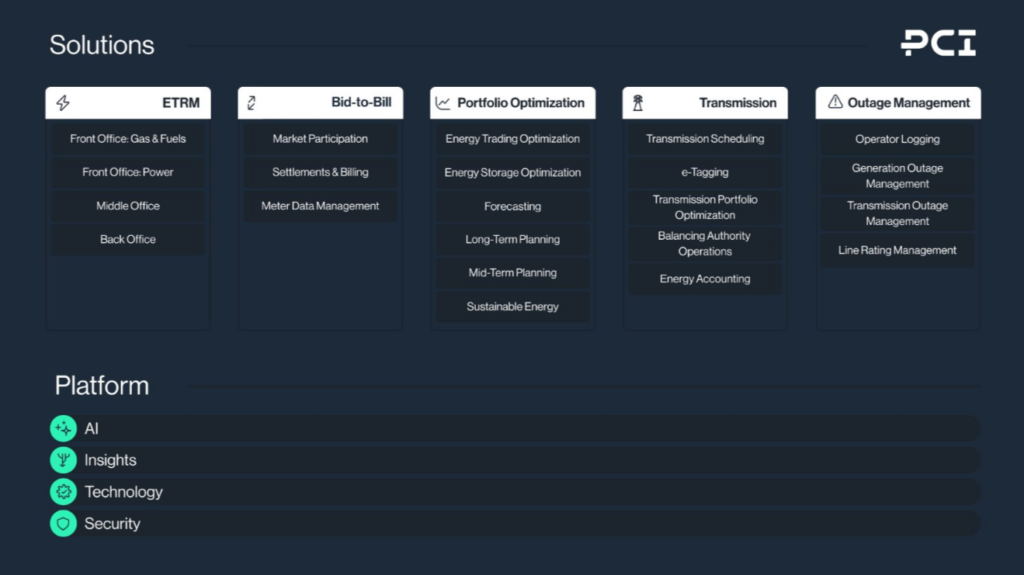
Diagram: PCI Energy Solutions’ five solution areas — ETRM, Bid-to-Bill, Portfolio Optimization, Transmission, and Outage Management — with platform pillars AI, Insights, Technology, and Security
Portfolio Optimization is where we started. It’s still embedded in the whole workflow today. We built it to give power companies the ability to run short-term, mid-term, and long-term simulations across a thermal, hydro, and renewables portfolio, from near real-time decisions to 20- or 25-year studies.
From there, we moved into supporting participation in power markets, which is what our Bid-to-Bill product line covers: bidding, front office, settlements, shadow settlements, invoicing, and the mid-office controls that go with managing bids and portfolio limits.
Several years ago, we extended further into trading for bilateral contracts, financials, and exchanges across power, gas, and fuels, along with the risk management and credit control features expected of a full Energy Trading and Risk Management (ETRM) system. That system is purpose-built for power companies operating in RTO-driven, vertically integrated, or bilateral market environments.
Transmission solutions round out the platform, covering balancing authority operations such as e-tagging, transmission portfolio optimization, energy accounting, and transmission scheduling.
No end-to-end platform is complete without outage management, and that’s the fifth piece. Our Outage Management solutions cover the full workflow of taking outages, making it available on the power marketing side, and communicating with reliability coordinators for approval/scheduling. We’ve also built a module specifically for line rating management, in response to FERC Order 881.
30 plus years of staying evergreen
We’ve been in business for more than 30 years, and the technology powering all of this has had to evolve right alongside us. Our philosophy has always been what we call evergreen: We keep the technology evolving underneath while keeping our customers’ operations flowing, without forcing anyone onto a new platform every few years.
We started in the early 2000s with a Java Enterprise stack: Oracle, WebLogic, an Oracle database on the back end. In the 2010s, we moved that stack into the cloud on AWS, where most of our clients now run their own instance of PCI inside a virtual private network with data segregation built in. A little more than five years ago, we went through another modernization effort, building what we call PCI Kube, a cloud-native technology platform we designed to power the next generation of products while staying seamless with everything else on the platform. We design it so customers shouldn’t need to know what’s running on what stack. Our goal is to create a smooth experience throughout, no matter where someone is in the process.
We’ve built every product on this upgraded Kube platform, including Insights, e-Tag+, Risk Management in the Cloud. It’s also our AI-ready foundation, and it’s where a growing share of our work lives today. PCI Forecaster uses machine learning to sharpen load, wind, solar, and price forecasts. PCI BatteryTrader applies AI to storage dispatch and bidding. And PCI Insights lets teams ask questions in plain language and get answers grounded in their own data. We keep building toward more automation and more agentic capability across these workflows, and we expect that to keep expanding.
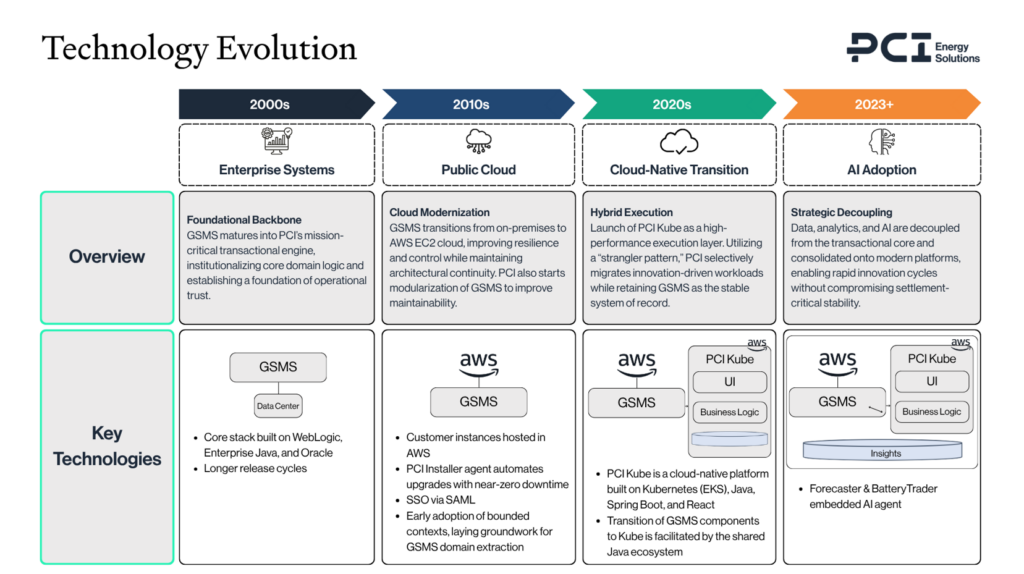
Diagram: PCI Technology Evolution’ enterprise systems, public cloud, cloud-native transition and AI adoption
Where to go from here
That’s the big picture. Five solution areas, one platform, and 30 years in the making. If one of those five areas caught your interest, that’s the best place to start.
If you’d like to talk through how PCI fits your organization specifically, contact us here — we’re happy to walk through it.