










Every wholesale electricity market has a category of participant whose entire job is turning small things into something big enough to matter. Aggregators combine curtailable load, rooftop solar, batteries, EVs, and other behind-the-meter resources into a single asset that can register, bid, and get dispatched, something almost none of those small pieces could do on its own.
Aggregation is not a new idea, but it’s a fast-growing one, especially as hyperscale data centers eye curtailment and demand flexibility to get interconnected faster. Here’s how each market defines the aggregator, what sets it apart from a Load Serving Entity, and why it matters for the large loads, data centers especially, weighing whether to become aggregators themselves.
What aggregators do
An aggregator’s core function is combining lots of small assets into one thing large enough to clear a market. In their simplest form, they do this to create “virtual” demand response resources or “virtual” generators; the two core use cases this piece focuses on. Aggregators can also aggregate storage and mix and match resource types under market rules, producing entirely new ranges of resource characteristics.
There are two main aggregation models. Demand-side aggregation bundles curtailable load across end-use customers (offices, factories, data centers, even residential smart thermostats) into a single dispatchable resource. Aggregators are especially successful with smart thermostat and commercial HVAC aggregations. Distributed Energy Resources (DER) aggregation bundles distributed energy resources (rooftop solar, batteries, EVs, and other behind-the-meter assets) into a single resource that looks and bids like a small power plant.
Either way, the End Use Customers behind these resources are not, individually, large enough or sophisticated enough to interconnect, register, bid, and get dispatched as wholesale market participants on their own. The aggregator absorbs that complexity: metering, telemetry, baseline calculation, performance measurement, settlement, so the underlying customer doesn’t have to become a market expert.
How do aggregators participate — and what to call them
Every ISO invented its own vocabulary for the same basic idea, and forma terminology doesn’t always include the word “aggregator.”
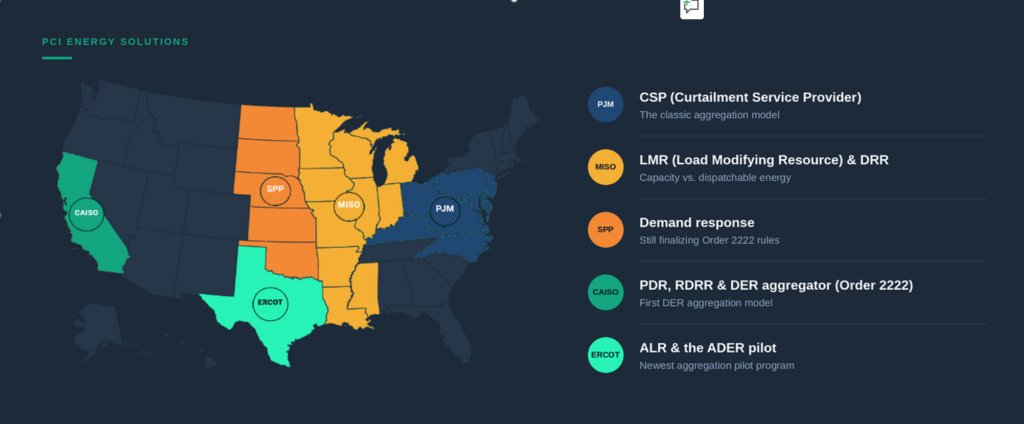
Same aggregator role, five different names: how PJM, MISO, SPP, CAISO, and ERCOT each structure the market.
In PJM, the model is the Curtailment Service Provider (CSP), the classic model. A CSP registers, recruits, and contracts with end-use sites, and bids the aggregated curtailment into PJM’s Emergency and Economic Demand Response programs, as well as the capacity market. PJM also allows multiple CSPs to register different services off the same facility, one CSP handling capacity, another handling energy, which most other ISOs don’t permit yet.
In MISO, the relevant categories are Load Modifying Resources (LMRs) and Demand Response Resources (DRRs). LMRs provide capacity in MISO’s Planning Resource Auction and get called during emergency operating procedures. DRRs offer into the energy and ancillary services markets (spinning and supplemental reserves, for example) on a dispatchable basis. MISO has historically allowed a single site to dual-register as both, but that’s changing. MISO is moving to eliminate dual registration of LMRs as Emergency Demand Response Resources starting with the 2026/27 Planning Year, partly in response to FERC scrutiny.
In SPP, the category is simply Demand Response. SPP has supported demand response participation since the introduction of the Integrated Market, but continued stakeholder debate on its FERC Order 2222 implementation has slowed broader aggregator implementations into the future.
CAISO’s categories are Proxy Demand Resource (PDR), Reliability Demand Response Resource (RDRR), and now DER aggregators under Order 2222. CAISO was the first ISO to build a DER aggregation model and implemented full Order 2222 compliance on November 1, 2024, lowering its minimum aggregation size to 100 kW and creating a “heterogeneous” aggregation model that can blend generation, storage, and demand response inside a single resource.
ERCOT’s categories are Aggregate Load Resources (ALR) and the Aggregate Distributed Energy Resource (ADER) pilot, ERCOT’s latest implementation for aggregating solar, storage, and DR behind a single interconnection point. ERCOT also has a longer-standing program, Emergency Response Service (ERS), which functions as aggregator-recruited load curtailment.
Aggregators are not the same as Load Serving Entities
It’s easy to conflate an aggregator with a Load Serving Entity (LSE), since LSEs may also manage multiple loads, generators, and storage assets, but they are not the same. LSEs have a greater obligation: they serve native load, procure capacity to cover it, carry reliability obligations, and answer to a state regulator for retail rates. An aggregator has a narrower regulatory obligation. Its business model is a bilateral contract with the end-use customer, and depending on the business model, it may connect directly to the ISO or integrate its virtual resources with an LSE for ISO submission. The aggregator is not directly responsible for serving customer load.
End-use customers sign up with an aggregator, or several, in PJM’s split-registration world, to monetize flexibility. Critically, the customer’s retail relationship with its utility or LSE doesn’t go away; the aggregator layers a wholesale-market relationship on top of it. Most tariffs require careful guardrails against double-compensation: getting paid twice for the same megawatt, once at retail and once at wholesale.
Data centers and other large loads can benefit from the aggregator concept. A hyperscale facility with backup generation, battery storage, or genuinely curtailable IT load is a natural aggregation candidate, either self-registering directly as a large single resource, or contracting with a CSP or aggregator to handle market mechanics while the data center focuses on uptime. Large loads are also exploring becoming their own aggregator, even their own LSE, to accelerate their interconnection process.
The ISO/RTO sees the aggregator as another market participant. The ISO’s focus is on whether the resource can be metered, verified, and dispatched reliably. As aggregator’s capability has expanded, ISOs are beginning to count their flexibility toward capacity requirements and ancillary service requirements, a shift from viewing them purely as an economic instrument. A significant challenge to aggregator participation is coordination between aggregators and utilities over visibility, notification during unplanned curtailment, and avoiding double-counted or over-credited resources.
Markets evolution
The introduction of the aggregator is a significant component of scaling FERC Order 2222. As each ISO reports and shares its successes with the various programs, we can expect further evolution, conformity, and advances in market policies, practices, and instruments.
The choice ahead: use aggregation or become one
The aggregator model is still being written into market rules in real time. MISO is tightening dual-registration requirements, SPP is still working through its FERC Order 2222 implementation, and ERCOT’s ADER pilot is the newest entrant of the group. As each ISO reports on its own programs, expect more convergence in how these markets define, measure, and compensate for flexibility. The question for large loads, data centers included, is no longer whether aggregation is a viable path. It’s whether to use one or become one.
How PCI can help you compete
Whether you’re an aggregator managing bids across multiple ISOs, an LSE navigating the guardrails around double-compensation, or a large load weighing whether to build your own aggregation capability, PCI GenManager gives you the tools to submit and manage offers into wholesale markets with confidence. Talk to our team →
Find out more on what PCI GenManager can do for you.
Want to explore a specific ISO’s market structure interactively? Try the PCI ISO Bot.