










Power markets clear hourly, and in many regions every five minutes, around the clock. Gas markets run on the gas day, a 24-hour window that begins at 9:00 a.m. Central Clock Time no matter where your assets sit. The power day runs midnight to midnight in market time. If you operate a gas-fired fleet, every commitment decision you make sits on top of that offset: nine hours if you are in the Central time zone, and some other number everywhere else.
Most people in the industry know this, but fewer have calculated the cost or identified where it actually lands.
Start with a single deadline. Timely nominations for tomorrow’s gas day are due at 1:00 p.m. Central. Most ISO day-ahead markets publish awards after that, and reliability unit commitment results land later still. So the gas position for tomorrow gets committed before anyone knows what the power market awarded. That happens every day, not just on difficult ones.
Two markets, one operator, no common clock
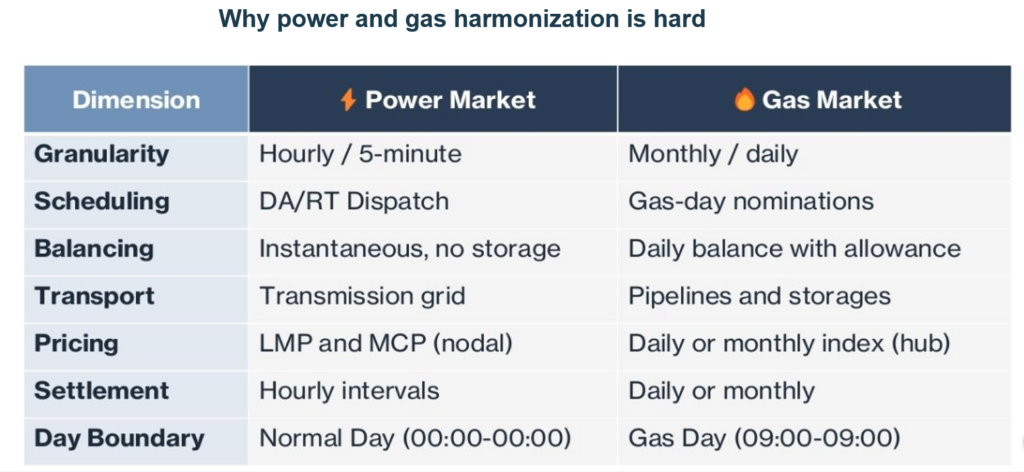
The mismatch between power and gas isn’t limited to scheduling. It shows up in every dimension of how these two markets operate.
Credit: Buck Feng, Chief Technology Officer, PCI Energy Solutions, PCI INFOCUS Conference 2026 presentation.
Seven dimensions, seven mismatches. Power balances instantaneously and cannot be stored, while gas balances across the full gas day inside tolerance bands, with storage and line pack as buffers. Power prices are nodal and reset every interval. Gas prices are hub-based daily or monthly index. Power settles hourly; gas settles daily and trues up monthly. Each of these conventions makes sense for its own commodity. The trouble starts when one organization has to satisfy both of them at the same time.
The people managing both systems are often the same people, or they sit 10 feet apart and coordinate by phone, juggling schedules, tags, bids and offers, nominations, trading, and imbalances at the same time. No amount of training fixes that, because the problem is structural. The asymmetry is what makes it expensive: Power positions stay adjustable until minutes before delivery, while gas positions lock in early and change only a few times a day. Flexibility on the power side of the house becomes exposure on the gas side.
Where the bandwidth runs out
Here is where the cost hides. Under NAESB standards, a pipeline day offers five nomination cycles: Timely and Evening before the gas day begins, then three intraday cycles. The last of them closes at 7:00 p.m. Central. After that, there is no further nomination window until the next day’s Timely cycle, roughly 14 hours that cover the overnight wind swing and the entire morning load pickup. The power market keeps clearing every hour of it.
Any adjustment inside that window is a workaround: an operational balancing agreement, a storage draw, a spot trade with whoever is still at a desk, or accepting the imbalance and paying for it. Imbalance is rarely priced at index. Cash-out provisions penalize deviations outside the tolerance band, and the further outside you land, the worse the price, so the cost of a missed projection grows with how late you find it. This is the hidden cost in the headline, and nobody budgets for it. It arrives weeks later on a pipeline statement that no one traces back to a particular bid. When teams manage this with spreadsheets and pipeline portals, the constraint isn’t the portfolio. It’s the workflow. (See the PCI blog post: “What to Look for in Natural Gas Software.”)
What NERC is telling us
This is not just an operational inconvenience. It is a documented reliability concern. NERC’s 2025–26 Winter Reliability Assessment found that gas-electric timing misalignment continues to challenge generator fuel procurement, particularly when severe cold falls over a holiday weekend. The joint FERC and NERC review of the January 2025 arctic events reached the same conclusion from the other direction. Generator cold-weather performance had measurably improved, and the gaps that remained were structural: market time frame incompatibility, and a lack of visibility on the electric side into what is happening on the gas side. The industry has made real progress on the parts of this problem that respond to weatherization. Timing misalignment is not one of them, and the exposure grows with every gas-fired megawatt that clears interconnection.
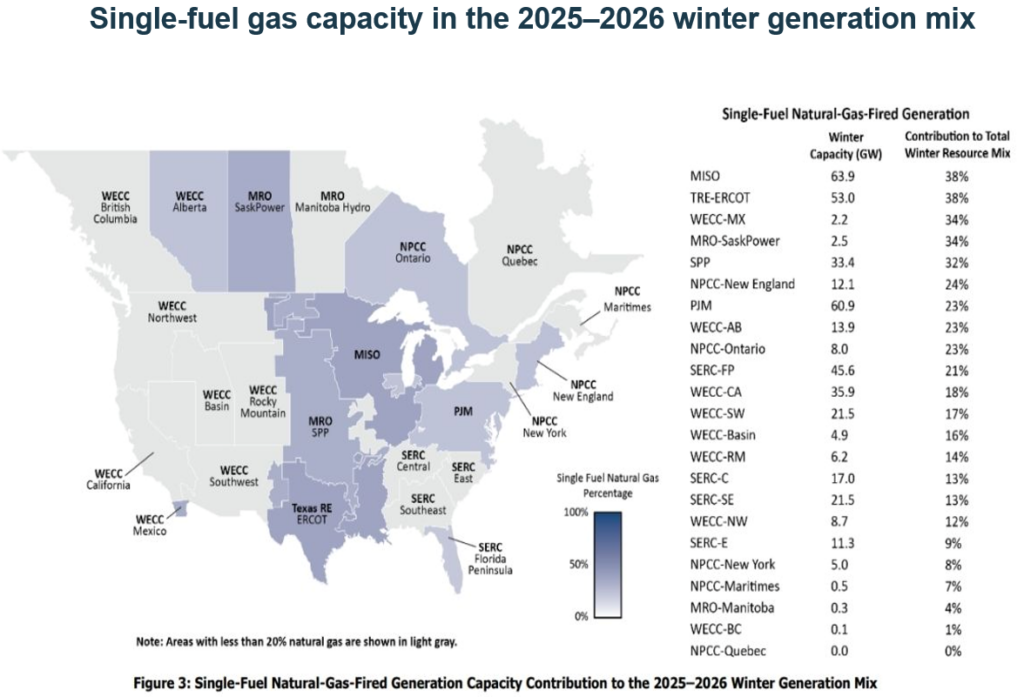
Source: NERC, 2025–2026 Winter Reliability Assessment, November 2025, Figure 3. Full report: https://www.nerc.com/globalassets/our-work/assessments/nerc_wra_2025.pdf
Single-fuel natural-gas-fired generation makes a large contribution to the on-peak winter resource mix across much of North America. If coordination fails during a peak demand event, those units have no fallback.
Keys to power & gas harmonization
Any workable solution starts where the constraint actually lives. Power people think in generating units, each plant with a heat rate, a fuel cost, and an expected dispatch. Gas does not work that way. Gas arrives at pipeline points, and one delivery point often serves several plants. Must-take volumes, maximum delivery limits, and tolerance bands are contractual terms at the point rather than at the plant, and imbalance is measured there. A fleet can look healthy unit by unit while the aggregate behind a single delivery point quietly runs past a contractual limit.
The first key is projecting burn at the pipeline point: metered burn to date plus forecast remaining-day burn from current awards, dispatch, and unit availability, measured continuously against the contractual band. Tracking burn at the plant creates a settlement surprise. Projecting it at the point reveals the issue while there is still a nomination cycle available to act.
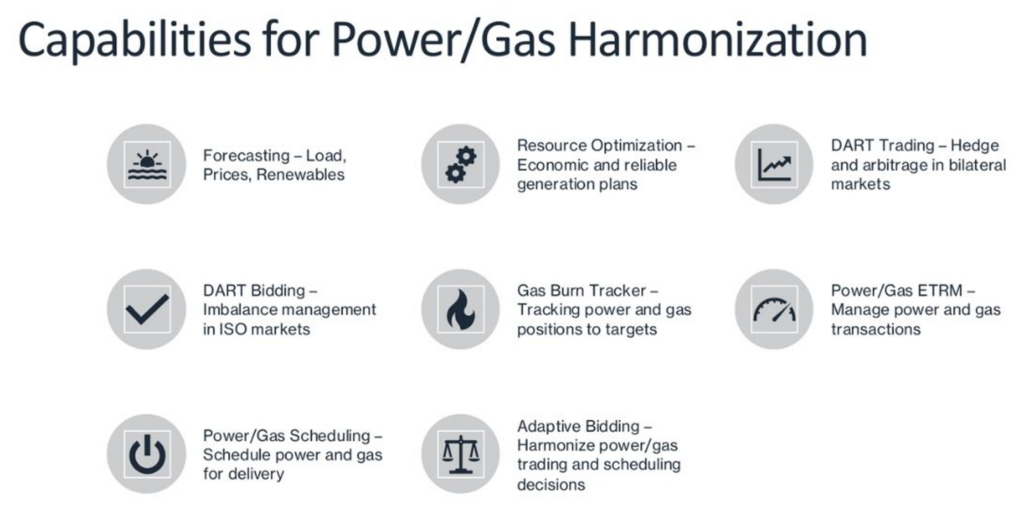
The second key is that the projection must reach the decisions capable of acting on it. The decision support platform needs to span both sides: forecasting, resource optimization, Day-Ahead and Real-Time (DART) trading, DART bidding, gas burn tracking, power and gas ETRM, power and gas scheduling, and adaptive bidding, all connected and all working from the same data.
Credit: Buck Feng, Chief Technology Officer, PCI Energy Solutions, PCI INFOCUS Conference 2026 presentation.
Adaptive bidding closes the loop. When projected burn at a point runs above target, the system raises the offer curve for the units behind it. A higher offer clears less often and at lower levels, and less generation means less gas. When burn runs below a must-take, the curve moves the other way. The gas position shapes the power bid continuously, in the market where flexibility still exists, rather than being reconciled after the fact in the market where it does not. This is the same adjustment an experienced trader would make by hand, applied at every point in every interval.
Harmonization is not just a configuration change. It depends on two fundamentals: a shared data foundation, so forecasting, trading, scheduling, and settlement are not working from separate versions of the truth; and a shared definition of success, so the power desk and gas desk are not measured against different outcomes. Organizations that get both right run this loop every day, in normal conditions and during cold events. Organizations that miss either one may have a strong projection, but no one acts on it.
What one customer found
At the PCI INFOCUS Conference 2026, a large electric cooperative with a diverse gas and wind fleet operating outside the traditional RTO structure described how it rebuilt scheduling on the PCI platform. Before the shift, scheduling depended on fragmented systems and manual workflows, with teams entering the same data in multiple tools and much of the operating knowledge held in people’s heads.
After the shift, gas management moved into one system with automated pipeline communications, tariff-aware cost modeling, and system-driven imbalance management. Schedulers spent less time entering data and more time making decisions.
Harmonization is already in production
Everything above exists today. The PCI Energy Solutions harmonization suite projects gas burn at pipeline points and connects that projection to the decisions that can act on it: optimization, trading, bidding, and scheduling, on both sides of the fence. Operators running it hold aligned positions, carry less imbalance exposure, and spend the last hour of the gas day deciding rather than rebuilding a spreadsheet.
The gas day and the power day will not merge. Whether the layer between them is a platform or a phone call is up to you. If it is still a phone call, let’s talk.

To discuss how harmonization applies to your portfolio, contact us at [email protected].