









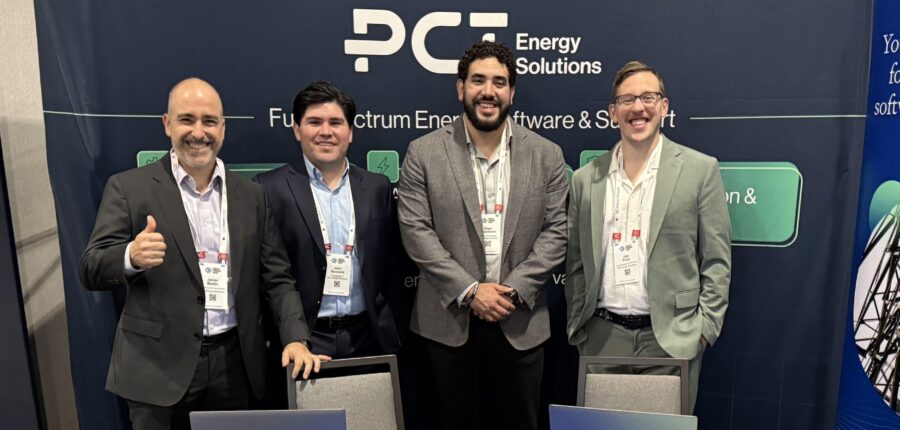
Last week, I returned from the ETWA Americas 2026 conference in The Woodlands. I want to extend a huge thank you to Howard Walper and the team at Commodities People for organizing an event that has rapidly become a premier gathering for our industry. Having attended this conference for the past three years, it has been fascinating to watch the audience evolve. The first year was heavily dominated by trading companies and service providers, the second year brought an influx of power producers, and this year featured a truly diversified mix of physical and financial players alongside software vendors. Notably, for the first time, I was able to spend time with several PCI customers from the utility space who were attending, clearly demonstrating that the need for modern energy trading platforms is no longer limited to pure trading players.
I had the privilege of speaking on a panel titled “Power – Mission Tomorrow: New Strategies for the Energy Frontier” alongside innovators from trading exchanges and power trading companies. During the session, I positioned myself as the representative for the “physical grid reality” side of the table. While it sometimes seemed I was taking a contrarian view, our panel reached a strong consensus: In the US, efficient financial power markets require well-functioning, fast, and transparent RTO markets.
Here are a few key takeaways and themes from our discussion on the future of energy trading.
Financial innovation requires sound physics
There is sometimes a misconception that financialization, tokenization, and high-frequency trading are at war with grid physics. The reality is that neither RTOs nor exchanges can substitute for one another. Because electricity cannot be stored at scale and balances continuously, market velocity, information, and economic incentives act as our “virtual inventory.” RTO 5-minute Locational Marginal Prices (LMPs) provide the foundational settlement baseline that enables financial exchanges and high-frequency trading to act as shock absorbers. Ultimately, until a token can resolve a transmission constraint, wholesale power remains firmly anchored to the physical grid.
The centralization & complexity paradox
People outside our industry frequently talk about decentralizing energy, but wholesale RTO markets are actually driving toward greater centralization and exponential complexity. Balancing Wyoming wind, California solar, and Phoenix data center load requires a massive optimization footprint, which is driving expansions like CAISO EDAM and SPP Markets+. As markets shift to 5-minute scheduling intervals and FERC Order 2222 reaches behind the meter to dispatch virtual power plants, the pace is moving beyond human limits. No human trader can manually optimize and re-bid 50 battery and solar nodes every 5 minutes. This field reality has forced us to pioneer autonomous “Touchless Workflows,” linking SCADA and forecasts directly to RTO engines and alerting humans only by exception.
AI as a Bounded Copilot: We all dream of AI agents taking over trading desks, but we must recognize that Large Language Models are inherently probabilistic, while wholesale grid operations are strictly deterministic. We cannot allow an AI model to hallucinate a 5-gigawatt dispatch schedule or violate FERC and NERC market monitor rules. Instead of replacing desks, AI should serve as a Copilot bounded by deterministic guardrails, giving scarce domain experts superpowers by eliminating administrative data entry. We are evolving from a “System of Record” to a “System of Context.” Instead of spending 45 minutes in spreadsheets, a trader can ask in plain English why they missed P&L yesterday, and the AI will diagnose the gap while deterministic engines safely lock in physical ramp rates and state-of-charge limits.
Data Centers and the “Compute Spread”: My favorite moment of the panel occurred when we shifted the conversation to data centers and power market access. As we dug deep into the topic, I couldn’t stop myself from surveying the room: “How many of you work for a hyperscale or data center operator?”
No hands were raised — exactly as expected, given the audience was mostly power traders and producers.
I followed up: “Don’t you think it is strange that we spend so much time at these conferences talking about the needs of data centers, and there are no data center people in the audience or on the panels?” As the room nodded in agreement, I shared my forecast: In less than two years, 25% of the audience at this conference will be power traders or power procurement specialists working for data centers.
We are officially transitioning from the 1990s era of the “spark spread” (gas to power) to today’s “compute spread” (electricity cost per MWh versus the revenue value of an AI token). To bypass 5-to-7 year interconnection queues, hyperscalers are deploying on-site generation and must actively monetize that capacity in wholesale markets to offset gross grid costs. It is unavoidable that as power becomes the ultimate constrained resource for compute, intelligence, and economic development, large flexible load players will be incentivized to become highly active participants in RTO power markets.
Navigating this transition requires tight alignment between commercial strategy and software architecture. As we continue executing our 5-year product strategy converging physical grid constraints, sub-hourly settlements, and enterprise AI orchestration, I look forward to continuing these conversations with our clients and partners.
For further insights on the trends we discussed at Energy Trading Week or to explore how PCI can help support your organization’s goals, please reach out or join us at our 2027 INFOCUS Conference in Colorado Springs, Colorado!