












The back-office function that becomes a market-facing obligation on day one
Most discussions of entry into a new day-ahead market concentrate on its most visible elements: the offer stack, the co-optimized clearing engine, and the locational prices that result. Energy accounting seldom receives comparable attention. Yet for a utility transitioning from bilateral operations or from an imbalance-only service such as SPP’s Western Energy Imbalance Service into SPP Markets+, the accounting function is where the operating model changes most substantially. It ceases to be an internal exercise in reconciling a metered boundary and becomes a settlement-quality data obligation owed to the Market Operator each operating day.
When a utility joins SPP Markets+, the function that changes most on day one is energy accounting, not the offer stack or the clearing engine that usually gets the attention. What was once an internal reconciliation against a metered boundary becomes a settlement-quality data obligation owed to the Market Operator every operating day, complete with its own submittal deadlines, calibration math, and substitution rules for missing data. This piece walks through what that shift actually requires, and why treating it as a back-office detail rather than a go-live workstream is the mistake most utilities don’t discover until their first disputed statement.
From metered boundary to submittal obligation
Under bilateral operations, energy accounting is largely self-contained. A balancing authority controls to a metered boundary, nets its tie-line flows against scheduled interchange, and reconciles after the fact. The governing meter is the one both neighbors have agreed to at the tie point, and no external party depends on that revenue-quality data to settle its own position.
Markets+ reverses this relationship. Settlement no longer originates at the participant’s boundary; it originates at a Meter Data Submittal Location (MDSL). This is a defined point, confined to a single Settlement Area within a single Balancing Authority Area, at which the participant submits revenue-quality injection and withdrawal data to the Market Operator. The billable metering determinant on which every downstream charge depends is derived from that submittal rather than computed by the market from tie-line flows. Where a submittal is not received, the market does not pause: It substitutes a State Estimator (SE) value in the participant’s place. Data quality thereby becomes a market input rather than an internal reconciliation matter.
Calibration and unaccounted-for energy: a new step in the chain
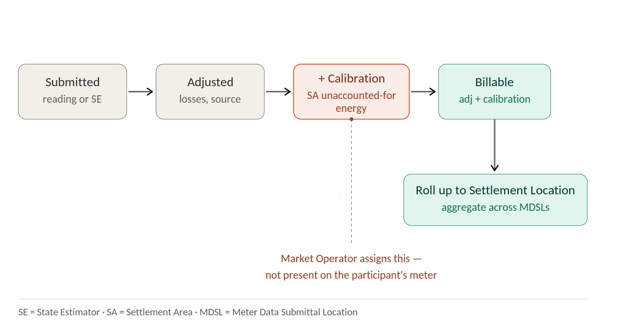
The construct with no clean bilateral analog is calibration. Because meter data is submitted per MDSL while energy must balance within each Settlement Area, Markets+ calculates unaccounted-for energy inside Settlement Area boundaries and incorporates a calibration quantity into each location’s billable determinant before the values are rolled up to the Settlement Location. Where a Settlement Location spans multiple MDSLs in different Settlement Areas, the determinant is an aggregation: calibrated first, then summed, and not in the reverse order.
This sequencing has a practical consequence: The quantity a participant is settled on is not the reading its meter recorded. It is the end of a short chain: the submitted meter reading, adjusted for losses and data-source substitutions, then combined with a calibration quantity the Market Operator assigns from the Settlement Area’s unaccounted-for energy. Because that calibration component never appears on the participant’s own meter, verifying a charge requires reconstructing the market’s chain rather than comparing against a single meter reading. That capability is what separates reading a settlement statement from being able to defend one.
Rules that exist because the market performs the accounting
Several handling rules arise precisely because the Market Operator, rather than the individual balancing authority, now owns the reconciliation:
- Missing-data substitution: Where a submittal is absent, the settlement system uses the State Estimator value; for Settlement Area tie-line and pseudo-tie flows, the SE value stands in until the final meter window closes
- Behind-the-meter demand response gross-up: Where metered load is net of behind-the-meter response, the value is grossed up for that response so the resource is credited for the quantity actually delivered
- Loss treatment on top-down submittals: Where a top-down calculation yields submittals that include transmission losses, the State Estimator value of the Settlement Area losses is backed out, ensuring a load is not settled on energy it did not consume
- Baseline-dependent demand response: Demand response settled under the calculated method must be tied to an MDSL for which baseline data is available to support that calculation; absent a baseline, the calculated settlement cannot be performed
Two clocks, two accuracy classes
A further shift is temporal. Markets+ energy accounting relies on two distinct data streams with different purposes. Real-time operating data received from SCADA through the EMS, at an approximately four-second scan and 90–95% accuracy. This drives ACE, AGC, and dispatch decisions in the moment. Revenue-quality meter data, at 5-minute or hourly granularity and 99.8–100% accuracy, drives final settlement after the fact. The operational picture that maintains reliability and the financial picture that settles the money are deliberately not the same figure, and energy accounting is the function in which the two are reconciled.
That reconciliation follows a defined calendar. Meter and schedule-adjustment data feed three scheduled settlement runs: an initial statement, a second pass, and a final statement. Each governed by its own submittal deadline. Data received after the final window closes can be addressed only through the dispute process. Under bilateral operations, a late correction is a matter of coordination between counterparties; under Markets+, it is a governed timeline with a firm close.
Why this function warrants early attention
Energy accounting is unglamorous, which is precisely why it is underestimated. The clearing engine will run regardless of whether any single participant’s meter data is complete. However, that participant’s charges will then be constructed from substituted State Estimator values rather than its own meters, and its calibration and loss adjustments will settle according to the market’s determination. Offer strategy attracts the attention; the accounting foundation determines whether the settlement a participant receives corresponds to the energy that actually moved.
For utilities preparing to enter Markets+, the practical implication is that meter data submittal, MDSL registration, and the calibration chain warrant treatment as a distinct go-live workstream rather than as a back-office detail to be resolved after the market opens. The function that once reconciled a boundary now settles a position, and it merits scoping accordingly.
Energy accounting is one piece of the operational shift Markets+ requires. See how PCI’s GenManager® suite handles energy accounting alongside portfolio optimization, generation and transmission management, and multi-commodity ETRM — built for the new SPP landscape.