











As the Western Interconnection moves toward SPP Markets+ go-live, e-Tagging is undergoing a meaningful redesign. Tags are no longer just a NAESB compliance artifact between two parties. Under Markets+, they become the operational interface linking every bilateral schedule, market-cleared transaction, and BA-to-BA transfer to the central market’s settlement, validation, and curtailment systems.
For Balancing Authorities (BAs), Transmission Service Providers (TSPs), Transmission Customers (TCs), Market Participants (MPs), and schedulers, this means familiar tagging practices need to be updated to reflect new tokens, new submitter roles, and new validation logic. Getting the workflow right is essential to avoid denied tags, missed settlements, and curtailment surprises.
This blog post highlights the most important Markets+ tagging workflow changes through six focus areas, with example tag structures based on the SPP Markets+ Interchange Scheduling Reference Manual:
- The universal MPLS Market Operator designation
- The two-location Misc info token rules (MPLS vs. MPLS_TRANSFER)
- Bilateral tags with optional IESSA-driven settlement
- Market Transfer Interface (MTI) tags: direct and jointly owned variants
- Market Opt-In Transfer Interface (MOTI) tags for non-adjacent BAs
- The forthcoming MITSPS construct and the MPSP placeholder
To illustrate the workflow changes, the examples below use Markets+ Participating BAs in Wave 1 (Oct 2027 participation) across the Western footprint: AZPS (Arizona Public Service), SRP (Salt River Project), PSCO (Public Service Company of Colorado), TEPC (Tucson Electric Power), and BCHA (BC Hydro).
The MPLS designation: how SPP recognizes a Markets+ tag
Before any Markets+ validation runs, SPP needs to know a tag belongs to Markets+. That signal is the MPLS value placed in the MO column on Source/Sink rows and on transmission segments meeting specific conditions, explained below.
Below example: A bilateral schedule from AZPS’s Ocotillo generator to SRP’s system load.
| BA | TSP | MO | PSE | POR → POD | S/E |
|---|---|---|---|---|---|
| AZPS | — | MPLS | MAG001 | Source: Ocotillo | — |
| — | AZPS | MPLS | MAG001 | OCOTILLO → PVEAST | AZPS |
| — | AZPS | MPLS | MAG001 | PVEAST → PALOVERDE500 | AZPS |
| — | SRP | MPLS | MAG001 | PALOVERDE500 → SRP_SYSTEM | SRP |
| SRP | — | MPLS | MAG001 | Sink: SRP_SYSTEM | — |
Every segment where an MTSP is providing Markets+ transmission, or where a Participating M+ BA is the Scheduling Entity, carries MPLS in the MO column. The Source and Sink rows where GCA or LCA is a Participating M+ BA also need to carry MPLS in MO column. Without it, SPP would not ingest the segment, and the MTU charge, Transmission Customer identification, and settlement mapping would all fail.
The Misc info field: two different tokens, two different sections
Markets+ Misc info tokens distinguish what type of tag is being submitted, and they live in different sections of the tag.
The MPLS token in the Physical Path Misc info field elevates a bilateral schedule to High Priority status.
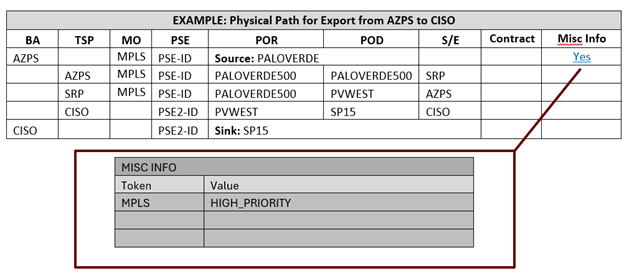
Three valid values in Misc info Field are recognized: WRAP_FS (WRAP Forward Showing), WRAP_HOLDBACK (deployed WRAP holdback), and HIGH_PRIORITY (non-WRAP firm with NERC Priority 6/7 transmission and attested supply). For background on WRAP and its role in Markets+, see our post “Why WRAP’s Next Chapter Matters for the Future of Western Markets — & Markets+.”
The MPLS_TRANSFER token in the Market Path Misc info field identifies the tag as a BA-submitted optimization transfer.
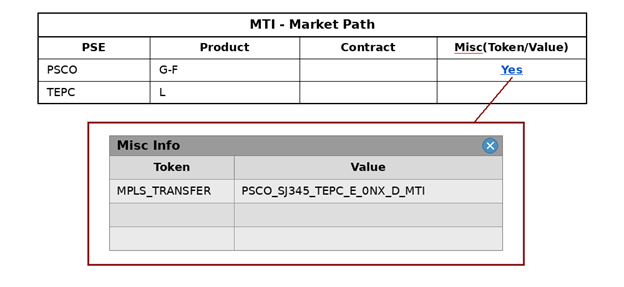
These tokens are not interchangeable, and placement matters. A WRAP holdback token placed in the Market Path, or an MTI name placed in the Physical Path, will fail validation.
Bilateral tags and the IESSA decision
Most internal Markets+ ↔ Markets+ bilateral schedules between Participating BAs do not technically require an e-Tag. But if either party wants to use the Internal Energy Schedule Settlement Adjustment (IESSA) to settle the bilateral at a chosen Settlement Location rather than at their respective resource and load LMPs, an e-Tag becomes mandatory.
Since IESSA settlement hinges on LMP, read our blog post, “How Locational Marginal Pricing Works.”
Example: AZPS sells 100 MW from Ocotillo to SRP at $45/MWh for HE14. Without IESSA, AZPS settles its Ocotillo injection at the Ocotillo LMP, SRP pays its load LMP, and the parties reconcile the difference outside the market via a side contract. With IESSA confirmed at the Palo Verde 500 Settlement Location, both parties’ settlements are formally adjusted at the Palo Verde LMP, and the residual is settled inside SPP rather than via a side contract.
This couples the tagging workflow with the settlement workflow in a new way. Schedulers and front-office traders now have to decide, at tag construction time, whether the bilateral will rely on IESSA. Both buyer and seller must confirm the IESSA and agree on the Settlement Location.
Market Transfer Interface (MTI) tags: when the BA is the submitter
For optimization-driven BA-to-BA transfers, Markets+ introduces a category where the Balancing Authority itself acts as the Creating PSE (CPSE) submitting the tags. These are market transfer tags (MTI/MOTI). Specifically, MTI tags come in two important variants.
Direct adjacency: Two Participating M+ BAs share a common scheduling point. After DAM clearing, the Market Operator determines AZPS should export 200 MW to SRP at Palo Verde 500 during HE14. AZPS submits the export side:
| Tag Element | Value |
|---|---|
| Submitter (CPSE) | AZPS |
| Market Path Misc Field | MPLS_TRANSFER =AZPS_PALOVERDE500_SRP_E_0NX_N_MTI |
| Source | AZPS_MPSP (Markets Plus System Point) |
| Sink | SRP_MPSP (Markets Plus System Point) |
| Settlement | None on the tag; energy already settled nodally |
SRP submits the paired import side. All Physical Path segments where M+ BAs are the S/E carry MPLS in the MO column.
Jointly-owned facilities in External BA: Two M+ BAs whose connecting transmission is owned by M+ MTSPs but physically located in non-M+ BA territory. For example, PSCO and TEPC may transfer energy across jointly owned transmission that physically runs through SWPW and PNM. The tag is still an MTI because the underlying transmission service is provided by M+ MTSPs through their ownership share, not by a non-M+ TSP opting in. The Physical Path looks like:
| BA | TSP | MO | PSE | POR → POD | S/E |
|---|---|---|---|---|---|
| PSCO | — | MPLS | PSCO | Source: PSCO_MPSP | — |
| — | PSCO | MPLS | PSCO | PSCO → HDN | PSCO |
| — | PSCO | PSCO | HDN → CRG | SWPW | |
| — | PSCO | PSCO | CRG → SJ345 | SWPW | |
| — | TEPC | TEPC | SJ345 → SJ345 | PNM | |
| — | TEPC | MPLS | TEPC | SJ345 → TEPC_MPSP | TEPC |
| TEPC | — | MPLS | TEPC | Sink: TEPC_MPSP | — |
The MW values on all MTI tags: direct adjacency or jointly owned come directly from market optimization output (DAM clearing, Pre-RTBM SCED, and 5-minute RTBM SCED for dynamic transfers). The energy is already settled at the underlying resources and loads, so the tag is purely a WECC-compliance and BA-coordination wrapper.
Market Opt-In Transfer Interface (MOTI) tags: for non-adjacent BAs
MOTI comes into play when two Participating M+ BAs cannot be connected via M+ MTSP transmission and the transfer requires transmission service contributed by a non-M+ TSP through formal opt-in registration.
Below example: BCHA exports to AZPS, threading through BPAT, IPCO, and PacifiCorp.
| BA | TSP | MO | PSE | POR → POD | S/E |
|---|---|---|---|---|---|
| BCHA | AZPS | MPLS | PWX01 | Source: BCHA_MPSP | — |
| — | BCHA | MPLS | PWX01 | BCHA → BC.US.BORDER | BCHA |
| — | BPAT | PWX01 | BC.US.BORDER → LAGRANDE | BPAT | |
| — | IPCO | PWX01 | LAGRANDE → BORA | IPCO | |
| — | PPW | APS01 | BORA → FOURCORNE345 | PACE | |
| — | AZPS | MPLS | AZPS | FOURCORNE345 → APS.SYSTEM | AZPS |
| AZPS | — | MPLS | AZPS | Sink: AZPS_MPSP | — |
The token in the Market Path is MPLS_TRANSFER = BCHA_BC.US.BORDER_FOURCORNE345_AZPS_E_6NN_N_MOTI. The MOTI name encodes the export-side BA, the export POD, the import POR, the import-side BA, the direction, the priority, and the transaction type.
The opted-in transmission on BPAT, IPCO, and PacifiCorp is submitted by a separate PSE representing the Transmission Contributing Market Participant. MPLS appears in the MO column only on the M+ BA segments at each end and never on the non-M+ opt-in segments. These opt-in arrangements must be registered through the BA Workbook’s MOTI Transmission Service Details table before the tag will validate.
The clean distinction between MTI and MOTI is not adjacency but it’s whose transmission carries the energy. MTI = M+ MTSP transmission (including jointly owned shares). MOTI = non-M+ TSP transmission contributed through opt-in.
MITSPS and MPSP: a new construct for marketers without an internal counterparty
Currently in design and targeted for approval at the August 2026 MPEC, the Markets+ Interchange Transaction System Point Schedule (MITSPS) will allow MPs to participate in interchange at the boundary without an internal counterparty.
Below example: A marketer with no internal resource or load wants to import MWs from a CISO-area generator into the SRP footprint.
| Tag Element | Value |
|---|---|
| Submitter | Marketer's PSE |
| Source | Real external generator (in CISO) |
| Sink | SRP_MPSP (generic Markets Plus System Point with no internal counterparty) |
| Transmission | OATT TSR from the CISO/M+ boundary to SRP_MPSP |
| Market award | Required (DA or RT) |
| Settlement | CISO External Interface LMP |
| Curtailment treatment | Uncommitted Interchange: trimmed before high-priority and internal load |
The marketer arranges Open Access Transmission Tariff (OATT) transmission between the MPSP and the M+ boundary, secures a market award, and submits a confirmed e-Tag. The transaction settles at the External Interface LMP like a normal import. But MITSPS tags are treated as Uncommitted Interchange Transactions, meaning they will be curtailed first during periods of stress before high-priority transactions, internal load, and self-committed internal generation. This opens a new pathway for marketers, but with reliability trade-offs that need to be priced into the bidding strategy.
What this means for each audience
For Balancing Authorities: Tagging now sits at the intersection of operations, settlement, and market clearing. BAs need to be ready to submit MTI/MOTI tags as CPSE, apply 5-minute MW updates to Dynamic MTI/MOTI tags from RTBM SCED outputs, and maintain ICCP feeds to receive Dispatch Targets and incremental MW updates. The Market Operator now drives the MW value on these tags, so the BA’s job is faithful execution and reconciliation, not commercial negotiation.
For Transmission Customers and Market Participants: The first-pass validation rule is operational: MPLS in the MO column on every Markets+ segment where an M+ BA is GCA or LCA. After that, the right Misc info token signals the right tag type: MPLS with WRAP_FS / WRAP_HOLDBACK / HIGH_PRIORITY for High Priority tags, no token for plain bilaterals, and MPLS_TRANSFER only for BA-submitted Market Transfer tags. Getting these wrong means tags get denied or misclassified for curtailment ordering.
For Front-Office Traders and Schedulers: Two strategic decisions become tag-time decisions. First, whether to use IESSA on internal bilaterals which couples the trade’s settlement location to the tag and requires counterparty confirmation. (For a primer on how these markets interact, see our post “Day-Ahead vs. Real-Time Market: What’s the Difference?”) Second, once MITSPS is approved at the August 2026 MPEC, whether to participate at the boundary without an internal counterparty hence gaining a new participation pathway in exchange for first to be curtailed treatment under stress. Both decisions shape your tagging workflow and need to be made deliberately.
The bottom line: tagging is now a market-integrated workflow
Markets+ elevates the e-Tag from a NAESB compliance artifact into the central coordination point between commercial transactions, market clearing, and BA reliability. Six things change in practice: the universal MPLS MO designation, the two distinct Misc info tokens, IESSA’s coupling of bilaterals to tagging, MTI tags with direct and jointly owned variants, MOTI tags for non-adjacent BAs requiring opt-in transmission, and the forthcoming MITSPS construct.
For BAs, TSPs, TCs, MPs, and schedulers, mastering these workflow updates is foundational for participating in Markets+ smoothly when go-live arrives. Teams that update their tagging systems, validation logic, and operator training before the transition will find the new framework reliable and efficient. Teams that wait will likely see denied tags, missed settlements, and avoidable curtailment outcomes in the early operating days.