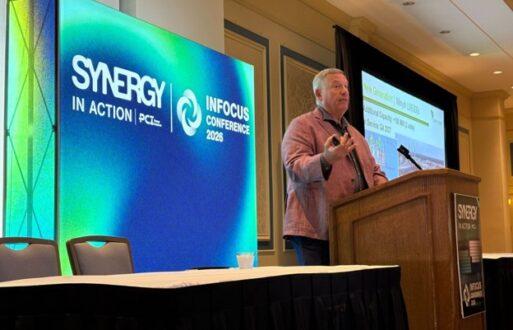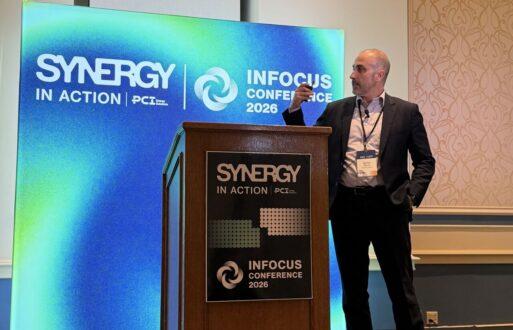









Let me start with a confession: More than 30 years later, I still measure risk by a single night at sea.
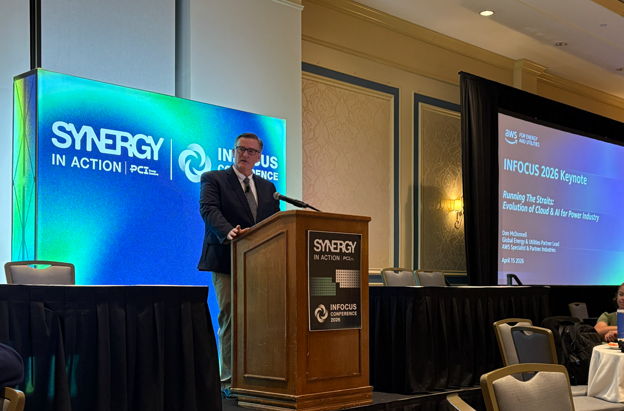
When PCI invited me to give a keynote at INFOCUS 2026, I knew the story I wanted to tell — because it has everything to do with the decisions you make in your trading operations every single day. It’s a story about running straits. The literal kind I ran as a young naval officer, and the metaphorical kind you run every day.
A night on the bridge
Back in 1991, I conducted 14 transits of the Strait of Hormuz. You all know that name from the news right now — that narrow thread of water between Oman and Iran, one of the most strategic waterways on Earth, where something like a fifth of the world’s energy traffic flows. When I close my eyes, I can still smell the diesel and the jet fuel in the air.
It was a tense time to be making those runs. Only 44 months earlier, an Exocet missile had ripped through the USS Stark and killed 37 sailors. I was young, recently married, and that fact ran through my head every time we drove through.
But it was one particular night that changed how I think about risk forever. I was officer of the deck near a minefield exclusion zone off the coast of Iraq. There was no moon. It was very dark. And then the call came in: one of our helicopters had a critical engine fault and needed to land immediately.
Here was the problem. We were approaching that minefield exclusion zone. Standard procedure called for a conservative buffer around the minefield boundaries — and the captain had set that buffer before he went to bed, exactly as he should have. If I followed the buffer, the helicopter wouldn’t make it. The crew would have to ditch in the ocean off the coast of Iraq.
Every instinct I had said respect the buffer. Respect for procedure and the captain’s orders was what had kept us safe across 14 transits. But I had something the procedure didn’t: real-time data. I had the helicopter’s actual emergency state and the current charted intelligence on the minefield. So at 23 years old, I made a call. I set engines to full and we cut through the extra margin of safety we’d added — not the minefield itself, but the buffer around it — based on what was actually happening, not on what the procedure had anticipated.
The helo landed with not one moment to spare. Had we delayed even 30 seconds, it would have crashed. When the captain woke and came up on deck, he agreed: we’d made the right call. And the pilot, Lieutenant Coombs, came bounding up and gave me one of those bear hugs where your feet leave the ground. I’ve carried that memory ever since.
Here’s the lesson I took from that night, and it’s the one I want to leave with you: real-time risk is a function of current data and current operational context. In war and in business, speed matters — but speed based on real-time information, not outdated assumptions. That’s what separates success from catastrophe.
Your straits keep shifting shape
So let me ask you the same question I keep coming back to. How many of you face pressure decisions every day in your trading operations? Maybe not life or death, but you feel the increasing pressure of market dynamics, of load growth, of volatility. Are you looking at current information, or at historical patterns and the way things used to be done?
Because the complexity you’re navigating is real, and it’s not slowing down. Consider just one signal of it. PJM, the largest grid operator in the country, peaked at roughly 153 gigawatts last year. Its long-term forecast now projects peak load growing by about 32 gigawatts between 2024 and 2030, and nearly all of that growth comes from data centers. That is a structural shift in demand the industry has never had to absorb at this speed.
Stack that on top of everything else you’re managing: supply challenges across multiple fuel sources, capital constraints in an inflationary environment, distributed generation and storage reshaping the grid, supply-chain disruptions, and evolving regulations across multiple jurisdictions. The number of variables, the speed of change, the interconnectedness of it all — it’s analogous to running the Strait of Hormuz. Only this is a strait that keeps shifting shape, and you’re running it 14 times faster than before. You’ll be called on to go faster still in the years to come.
The old curse goes, “May you live in interesting times.” We certainly do.
What the cloud actually changes
I’m from AWS, so let me strip the buzzwords out of “the cloud.” Simply put, it’s on-demand delivery of IT resources over the internet with pay-as-you-go pricing. Instead of buying, owning, and maintaining your own data centers, you access computing power, storage, databases, analytics, and AI as you need them. Think of it like the electrical grid: You don’t build your own power plant; you plug in and use what you need, when you need it.
Why does that matter for trading and risk management? Agility: You can experiment and innovate without massive upfront investment. Elasticity: You can scale up for peak trading periods and back down again. Cost savings: You pay only for what you use. And global reach: You can deploy capabilities in minutes.
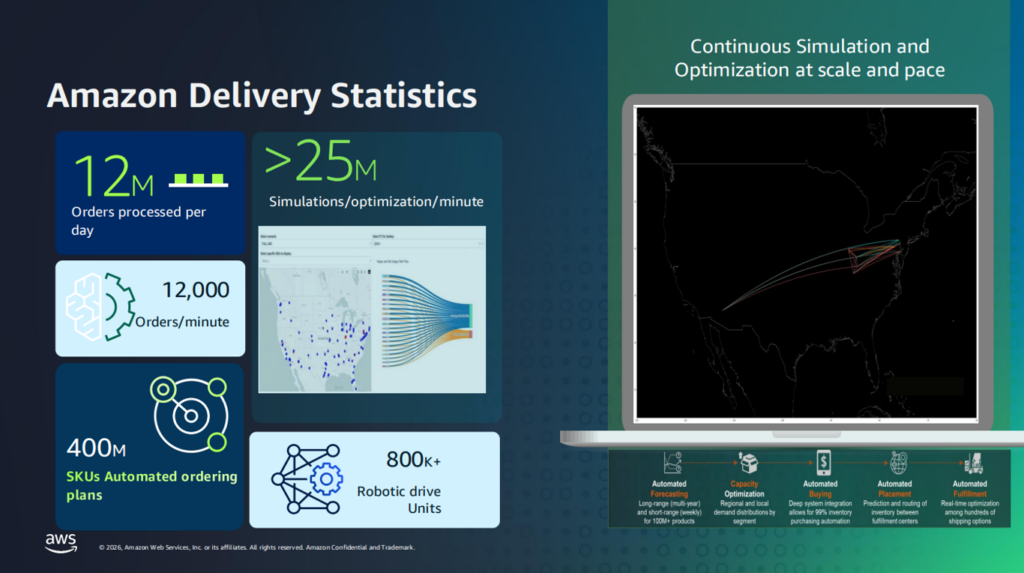
But the real power is that the cloud lets you do things that were simply impossible a decade ago. Let me use Amazon’s own operations as an example. We continuously simulate and optimize our delivery network at a scale that’s hard to picture: More than 25 million simulations and optimizations every minute, across millions of packages, thousands of routes, with real-time traffic and weather. That isn’t overnight batch processing. It’s real-time decision-making at scale.
Slide courtesy of AWS. © Amazon Web Services, Inc.
That same class of technology can optimize energy trading portfolios, risk management, and market strategies. And here’s why it fits your industry so well: The cloud’s unique strength is the ability to monitor, analyze, plan, simulate, optimize, and operate physical components and networks in real time, at massive scale and complexity. What is the power and utilities industry, if not a massive, complex physical network that operates dynamically in real time? Just as I needed real-time intelligence to navigate that minefield safely, you need real-time data and analytics to navigate today’s markets.
From procedural workflows to agentic ones
This brings me to the next frontier: agentic workflows powered by generative AI.
Traditional workflows follow fixed rules: If this happens, do that. Think of a flowchart. They’re predictable, but they’re inflexible. Agentic workflows use AI to make intelligent decisions within parameters that humans define. They can adapt to changing conditions, learn from outcomes, and optimize over time.
Think back to that helicopter decision. A procedural workflow would have said, “Maintain the buffer zone. No exceptions.” An agentic workflow would have said, “Analyze the current helicopter fuel and engine state, the current minefield intelligence, the weather, and the alternative landing options, then recommend an optimal course of action.” That’s where energy trading systems are headed: systems that don’t just execute rules, but make intelligent decisions and deliver insights to humans at machine speed.
This isn’t about ripping everything out. The most successful transformations I see use a hybrid approach: combining on-premises solutions with cloud components on a modern architecture. You keep stability and control where you need it, and gain agility where it matters most.
What it looks like in the field
Let me show you what this looks like in practice.
Ørsted, the global renewable-energy leader, ran into a challenge that’s becoming common as operators expand: their legacy trading system couldn’t keep pace with multiple ISOs, diverse asset types, and real-time trading across bilateral and exchange markets. Working with PCI, they deployed a cloud-based trading and risk management platform on AWS, gaining workflow automation, real-time portfolio visibility, and the scalability to support rapid growth. And this is just phase one; they’re already planning phase two.
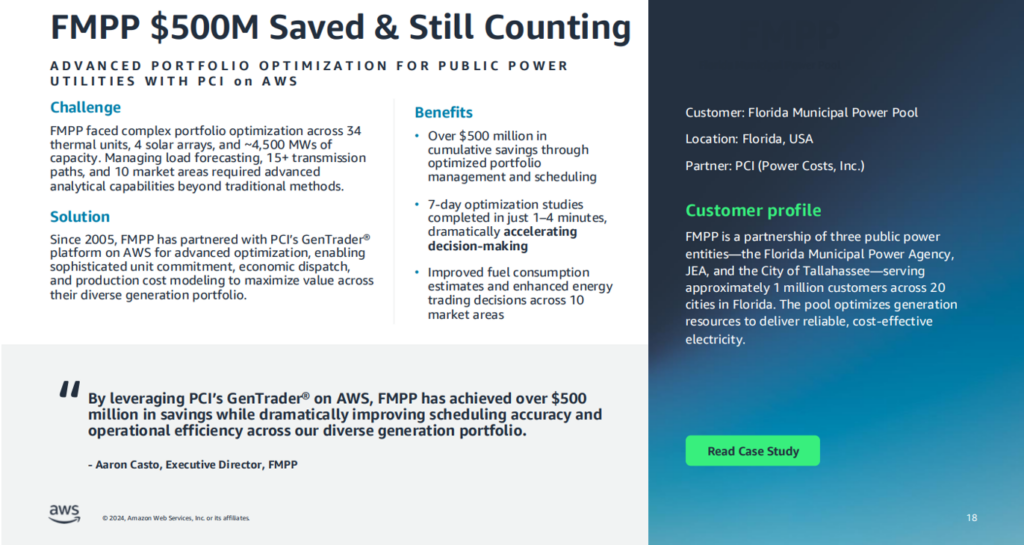
Then there’s Florida Municipal Power Pool. FMPP is a partnership of three public-power entities serving about a million customers across 20 Florida cities. Using PCI’s GenTrader on AWS, FMPP has accumulated more than $500 million in savings through optimized portfolio management and scheduling. Seven-day optimization studies that used to take far longer now complete in one to four minutes.
Slide courtesy of AWS. © Amazon Web Services, Inc.
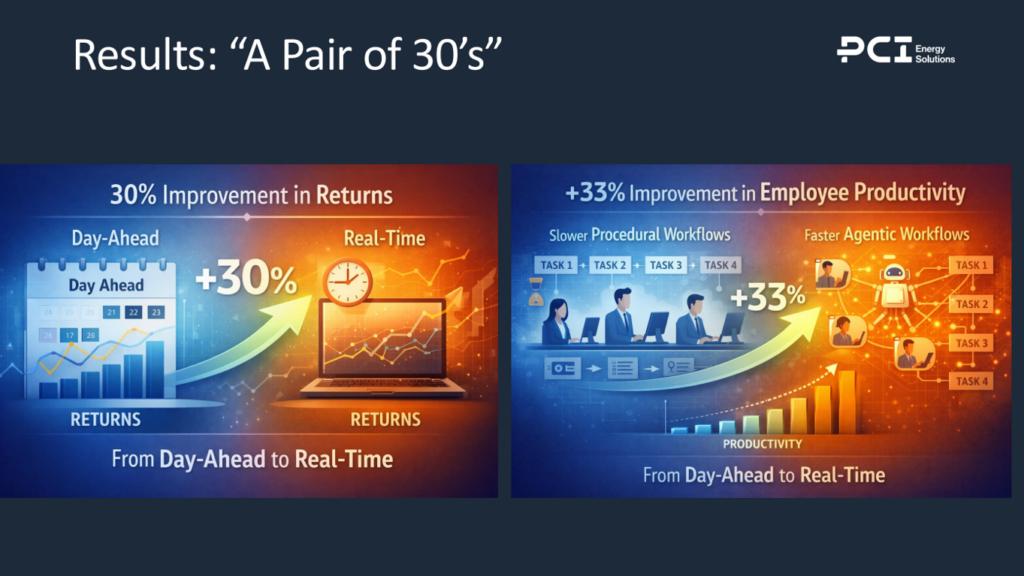
What are the broader results? PCI has a name for what it’s seeing across customers moving from day-ahead to real-time analytics: “a pair of 30’s.” Roughly a 30% improvement in returns, and a 33% improvement in employee productivity from agentic workflows. Those aren’t marginal gains. When your traders make better decisions faster, when your risk managers have real-time visibility into exposures, and when your operations team can respond to market changes in seconds instead of hours — that’s when you start pulling away from the pack.
Slide courtesy of AWS. © Amazon Web Services, Inc.
Speed is a leadership choice
That night on the bridge, I could have stuck with the buffer, avoided all the risk, and let the helicopter crew take their chances. No one would have blamed me. But my captain had created an environment where his team was empowered to use the best available information and challenge assumptions when the data warranted it. I’m grateful the culture of that ship let me make the right call.
That’s the choice you face now. Do you build an environment where your teams can use real-time data, AI insights, and cloud-scale computing to make better decisions? Or do you stick with procedures built for a simpler era?
Let me close with the rest of the story. Two years later, in 1993, we received no-notice contingency tasking to get to Somalia. American forces were under attack in Mogadishu and needed air support. We pushed the Chandler harder than I’d ever felt, full flank speed, the whole ship vibrating, faster than it was designed to run for any sustained period. We broke every speed record getting on station, and once there, we provided air-traffic separation for humanitarian flights for nearly a month. I remain deeply proud of the help we were able to give people in their time of need.
Here’s what that taught me: when the mission demands it, you can push past design limits and achieve things you never thought possible, but only if you’re willing to test yourself and your team. Our industry is known for being risk-averse, and for good reason; we serve the public good. That’s fundamentally a good thing, so long as it doesn’t hold us back. The companies winning in energy trading today aren’t the ones with the biggest legacy systems. They’re the ones that want to run fast and make decisions based on real-time data.
So I’ll leave you with the question I keep asking myself: what’s your strait? What are the constraints on your operations — and are you making decisions based on real-time information, or on the way you’ve always done it? The cloud and AI aren’t just technology upgrades. They’re enablers of a fundamentally different way of operating. And just as we got the Chandler on station faster than anyone thought possible, you can transform your trading operations faster than you think.
You just have to be willing to test yourself, test your team, and let AI amplify human potential — with humans defining the loops, building the loops, and controlling the loops.
Explore how AWS is helping power and utility companies make faster, data-driven decisions at aws.amazon.com/energy.
This blog post was adapted from a keynote presentation delivered at INFOCUS 2026, PCI’s annual user conference.